 Exploring
The First Aid Only 298-Piece is the best first aid kit for everyday home and office use — the most-reviewed kit in existence at 4.8 stars. The Surviveware Premium 238-Piece is the organized, waterproof pick for vehicles and camping, and the My Medic MyFAK steps up to genuine trauma capability for remote properties.
How We Picked
We compared contents quality (not just piece counts — 100 of those pieces are usually bandage variations), organization under stress, case durability and water resistance, trauma capability, and owner reports in the tens of thousands. A first aid kit is one leg of the preparedness stool — our emergency food guide and weather radio picks cover the others.
1. Best Overall: First Aid Only 298-Piece All-Purpose Emergency First Aid Kit

First Aid Only 298-Piece All-Purpose Emergency First Aid Kit
First Aid Only
- 298 pieces covering the full everyday-injury spectrum
- Soft case with clear internal pockets
- The most-reviewed first aid kit on Amazon, period
- OSHA-relevant contents for home and workplace
- Cheap enough to buy several — home, car, shop
- 4.8★ from 77,600+ owners
Why we picked it: Seventy-seven thousand reviews at 4.8 stars makes this the most-vetted first aid product in existence, and its role is exactly what the record suggests: the kit that handles the daily reality of cuts, scrapes, burns, splinters, and headaches. It is not a trauma kit and doesn't pretend to be — it's the one you keep in the kitchen, the shop, and the glovebox, at a price where buying three isn't a decision. Every household needs this layer before it needs anything fancier.
2. Best for Vehicles & Camping: Surviveware Comprehensive Premium Survival First Aid Kit, 238 Piece

Surviveware Comprehensive Premium Survival First Aid Kit, 238 Piece
Surviveware
- Labeled, color-coded compartments findable under stress
- Durable water-resistant case with MOLLE compatibility
- Contents chosen for field use, not filler count
- Straps to a pack, roll bar, or ATV rack
- The outdoor community's organizational favorite
- 4.8★ from 4,000+ owners
Why we picked it: In a real emergency you don't rummage — and Surviveware's whole design thesis is that organization is a medical feature. Every compartment is labeled by injury type, so the person helping (who may not be you) finds pressure bandages without dumping the bag. The water-resistant case with MOLLE straps lives happily on an ATV, in a truck, or lashed to a pack. Same 4.8-star rating as the First Aid Only, earned on build rather than volume.
3. Best Trauma-Capable: My Medic MyFAK Standard IFAK First Aid Kit
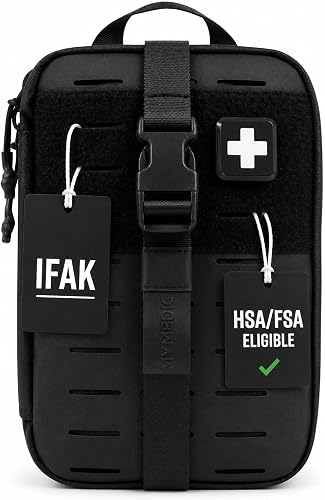
My Medic MyFAK Standard IFAK First Aid Kit
My Medic
- Genuine trauma layer: tourniquet-grade bleed control supplies
- IFAK format built on professional medical lines
- Mounts in a vehicle or on gear; grab-and-go design
- The layer that matters when help is 40 minutes out
- My Medic specializes in serious civilian med kits
- 4.7★ from 140+ owners
Why we picked it: Everything above treats injuries; this treats emergencies. On a property where chainsaws, tractors, ladders, and livestock are daily company — and the ambulance is 40 minutes out — the capability that matters is stopping serious bleeding in the first minutes, and that's what an IFAK carries that drugstore kits don't. My Medic builds to that standard for civilians. Buy it, and then spend an evening learning to use what's inside; the kit is only half the capability.
Comparison Table
| Pick | Kit | Contents | Case | Best for |
|---|---|---|---|---|
| Best Overall | First Aid Only 298-Piece | 298 pieces | Soft case | Home, office, everyday cuts |
| Best for Vehicles & Camping | Surviveware Premium 238-Piece | 238 pieces | Labeled + water-resistant | Truck, ATV, pack, camp |
| Best Trauma-Capable | My Medic MyFAK | IFAK trauma | Bleed control | Remote properties, chainsaw work |
What to Look For in a First Aid Kit
Piece counts are marketing; contents are medicine. A "300-piece" kit is routinely 200 adhesive bandages in five sizes. Read the actual manifest for the items that do work: pressure dressings, gauze rolls, triangular bandages, quality shears, tweezers, irrigation, and burn care. Ten capable items beat a hundred fillers.
Match the kit to the distance from help. In town, a drugstore-plus kit covers you until professionals arrive in minutes. Rural and off-grid, response times stretch toward an hour, and your kit needs the trauma layer — serious bleed control, splinting, and enough supplies to manage an injury for the duration. The honest question isn't "what might happen" but "how long until someone better equipped arrives."
Organization is a stress feature. Emergencies degrade fine motor skills and thinking — a kit that's a jumbled pouch becomes useless precisely when it's needed. Labeled compartments, color coding, and a layout a stranger could navigate are worth real money. Test yours: could a visiting relative find the pressure bandage in fifteen seconds?
Layer your kits like your risks. The working pattern for a rural property: an everyday kit in the kitchen, a compact kit in each vehicle, a field kit that travels to the woodlot or barn, and a trauma layer (IFAK) wherever the dangerous tools live. Duplication is the point — the kit you can reach in one minute outranks the better kit in another building.
Skills and maintenance complete the kit. A tourniquet you've never handled is a prop. Take a Stop the Bleed or wilderness first aid course — a weekend that outvalues any purchase on this page — and audit kits annually: replace used and expired items, check that meds haven't cooked in a summer glovebox, and restock what the family quietly raided for scraped knees.
Bottom Line: Which Should You Buy?
For everyday injuries: the First Aid Only 298-Piece. The most-proven kit on the market — buy one for every building.
For the truck and the trail: the Surviveware Premium 238-Piece. Labeled-under-stress organization in a case built for field life.
For when help is far away: the My Medic MyFAK. The bleed-control layer every remote property should have on the wall.
Made up your mind?
Each pick opens on Amazon, where the current price and stock are listed.
Frequently Asked Questions
What is the best first aid kit in 2026?
The First Aid Only 298-Piece is our best overall pick for 2026. The Surviveware Premium 238-Piece and the My Medic MyFAK cover the other cases this guide compares. See the comparison table below for specifications and owner ratings, then choose the one that matches your setup.
What should a good first aid kit contain?
Beyond the adhesive-bandage layer: pressure dressings and gauze rolls for serious bleeding, triangular bandages, quality trauma shears, tweezers, wound irrigation, burn dressings, gloves, and any personal medications. For remote properties, add a genuine trauma layer — tourniquet and hemostatic dressing — and the training to use it.
What's the difference between a first aid kit and an IFAK?
A first aid kit treats the everyday spectrum — cuts, scrapes, burns, sprains. An IFAK (individual first aid kit, a format from military medicine) is built around one job: keeping a seriously injured person alive until help arrives, centered on massive-bleeding control. Rural properties benefit from having both, because they answer different emergencies.
Where should I keep first aid kits on a rural property?
Layered by reach: one in the kitchen, one in every vehicle, one that travels with dangerous work (chainsaw, tractor, roof), and the trauma kit mounted visibly where the risks concentrate — the shop or barn. The rule of thumb: no working area should be more than a minute from bleeding control.
How often should I check and restock a first aid kit?
A full audit annually, plus an immediate restock after any use. Check expiration dates on ointments and medications, replace anything heat-damaged from vehicle storage, and confirm the family hasn't quietly emptied the bandage layer. Put the audit on the same calendar entry as smoke-detector batteries.
Is first aid training necessary if I have a good kit?
The kit without training is a box of potential; training converts it to capability. A basic first aid/CPR course plus a Stop the Bleed session covers the highest-stakes skills in a weekend. For genuinely remote properties, wilderness first aid teaches the extended-care mindset — managing an injury for hours, not minutes. It's the highest-return preparedness investment there is.
Keep reading


How this guide was put together
We shortlist from manufacturer spec sheets and manuals, confirm each listing is live on Amazon, and give owner reports from months of use more weight than first-week impressions. Contents change between kit revisions — verify the current manifest at the retailer, and remember that no kit substitutes for first aid training.
Safety note: A first aid kit supports emergency response — it doesn't replace it. For serious injury, call emergency services first, then treat. Check contents against expiration dates annually, store kits away from children while keeping them reachable in seconds, and get trained on any trauma equipment before you need it.