 Exploring
For most people, the Midland GXT1000VP4 is the best GMRS radio — proven range and easy to use. For serious power, the Midland GXT67 PRO puts out a full 5 watts. On a budget, the Retevis RB48 is rugged and well-rated.
How We Picked
We focused on transmit power (watts), real-world range, durability, battery life, and NOAA weather channels. GMRS radios work without any cell network — just license and talk. Pair them with an emergency weather radio for full off-grid awareness.
1. Best Overall: Midland GXT1000VP4 GMRS Two-Way Radio (50 Channel)

Midland GXT1000VP4 GMRS Two-Way Radio (50 Channel)
Midland
- 50 GMRS channels with privacy codes
- Long range in open terrain
- NOAA weather alerts built in
- Rechargeable battery packs included
- A best-seller for years, 4.4★
Why we picked it: The GXT1000VP4 is the GMRS radio most off-gridders cut their teeth on — solid range, weather alerts, rechargeable packs, and Midland's reliability. It does everything most people need without fuss. Best all-around GMRS radio.
2. Best Power/Range: Midland GXT67 PRO 5W GMRS Two-Way Radio (4 Pack)
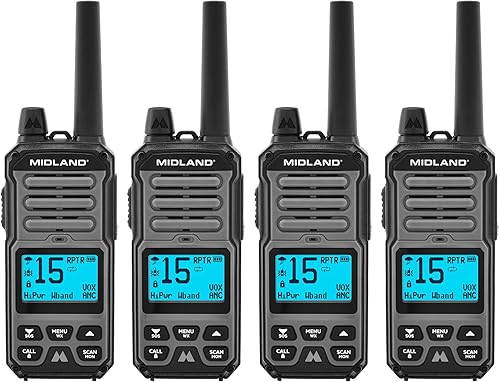
Midland GXT67 PRO 5W GMRS Two-Way Radio (4 Pack)
Midland
- Full 5-watt GMRS transmit power
- Detachable antenna for extra range
- NOAA weather scan and alerts
- Four radios for the whole group
- Rugged build, 4.4★ rating
Why we picked it: When range matters most — big property, mountains, a convoy — the GXT67 PRO's full 5 watts and detachable antenna reach farther than typical bubble-pack radios, and you get four in the box. Best GMRS radio for power and range.
3. Best Value: Retevis RB48 GMRS Walkie Talkies (Heavy Duty)

Retevis RB48 GMRS Walkie Talkies (Heavy Duty)
Retevis
- Heavy-duty, water-resistant build
- GMRS channels with NOAA weather
- Long-lasting rechargeable battery
- Loud, clear audio for the price
- Top-rated value at 4.6★
Why we picked it: Retevis built the RB48 tough and priced it right — water resistance, NOAA channels, and dependable battery life make it an easy way to equip a whole group without overspending. Best value GMRS radio.
Comparison Table
| Pick | Radio | Power | Pack | Best for |
|---|---|---|---|---|
| Best Overall | Midland GXT1000VP4 | Standard GMRS | 2 radios | Everyday use |
| Best Power/Range | Midland GXT67 PRO | 5 watts | 4 radios | Max range & groups |
| Best Value | Retevis RB48 | GMRS | Rugged pair | Budget setups |
Real-World GMRS Range: What the Numbers Actually Mean
The "36-mile range" on the box is line of sight between two mountain tops. Radio waves at GMRS frequencies (462–467 MHz) do not bend over hills or through dense timber, so range on the ground is set by terrain, antenna height and power — in that order.
| Situation | Handheld to handheld (5W) | Handheld to mobile/base with roof antenna | Through a GMRS repeater |
|---|---|---|---|
| Open flat land, rural | 3–6 miles | 8–15 miles | 20–40 miles |
| Rolling hills, mixed woods | 1–3 miles | 4–8 miles | 15–30 miles |
| Dense forest, mountain valleys | 0.5–1.5 miles | 2–5 miles | Depends entirely on repeater site |
| Suburban / in town | 1–2 miles | 3–6 miles | 10–25 miles |
Antenna height beats power. Going from 2W to 5W adds perhaps 20% to range; getting an antenna on a roof or a mast doubles or triples it. That is why a GMRS mobile radio with a vehicle antenna, or a small base station with a 20-foot mast at the cabin, transforms what handhelds can do. The handhelds here are the right tool for the pocket; a base at home is the second purchase.
Repeaters. GMRS is allowed to use repeaters — hilltop stations that rebroadcast your signal — and many rural areas have community repeaters that turn a 2-mile handheld into a 30-mile one. The Midland GXT67 PRO and Retevis RB48 support repeater channels (the "R" channels 15–22 with a +5 MHz offset); check the repeater's tone and ask the owner for permission, which is the etiquette. The GXT1000 does not do repeaters.
Setting Up GMRS for an Off-Grid Property
One licence covers the household. A GMRS licence from the FCC covers you and your immediate family for ten years, with no exam. Every radio in the family uses the same call sign. Get it before you transmit.
Programme the same channel and privacy code on every radio and write it on tape on the back. "Privacy codes" (CTCSS/DCS) do not make the channel private — anyone on the frequency can hear you — they just mute other traffic on your radios. Agree on a simple channel plan: one for the property, one for the road, one for emergencies.
Charging off-grid. All three picks charge from USB or a 12V cradle. A small USB solar panel or a solar power bank keeps a pair charged indefinitely; keep a set of AA batteries for the models that accept them (the GXT1000 does) as a dead-battery backup.
Weather alerts. Midland's NOAA weather scan is worth turning on at the cabin — it is a battery-powered weather radio you already carry.
When GMRS is not enough. If you need to talk 20+ miles without a repeater, or to reach people outside your group, look at handheld ham radios (licence exam required) or, for true no-infrastructure reach, a satellite communicator.
What to Look For
Transmit power. More watts means more range; 5W GMRS handhelds reach much farther than low-power FRS bubble-pack radios.
Antenna. A detachable or longer antenna improves range — fixed stubby antennas limit distance.
NOAA weather. Built-in weather channels and alerts add safety off-grid, warning you of incoming storms.
License. GMRS requires an inexpensive FCC license (no test, covers your whole family) — factor it in.
Bottom Line: Which Should You Buy?
For most people: the Midland GXT1000VP4. Proven range, weather alerts, easy.
For max range: the Midland GXT67 PRO. Full 5 watts, four radios.
On a budget: the Retevis RB48. Rugged and well-rated for less.
Made up your mind?
Each pick opens on Amazon, where the current price and stock are listed.
Frequently Asked Questions
What is the best GMRS radio in 2026?
The Midland GXT1000VP4 is our best overall pick for 2026. The Midland GXT67 PRO and the Retevis RB48 cover the other cases this guide compares. See the comparison table below for specifications and owner ratings, then choose the one that matches your setup.
Do GMRS radios need cell service?
No — GMRS radios communicate directly radio-to-radio with no network, towers, or internet, which is exactly why they're a staple of off-grid communication.
Do I need a license for GMRS?
Yes — GMRS requires an inexpensive FCC license in the U.S. There's no exam, and one license covers your immediate family for ten years.
How far do GMRS radios reach?
Real-world range is usually a few miles, more in open terrain or from high ground; advertised “30-mile” figures assume ideal line-of-sight conditions.
GMRS vs FRS radios?
FRS radios are license-free but limited to low power and fixed antennas; GMRS allows up to 5W (handheld) and detachable antennas for much greater range.
Can GMRS radios get weather alerts?
Yes — most GMRS radios include NOAA weather channels and alert tones, a valuable safety feature when you're off-grid and watching the sky.
What is the actual range of a GMRS handheld?
Handheld to handheld, expect half a mile to a mile and a half in woods or hills, three to six miles across open flat country, and only the advertised 30-plus miles from one summit to another. Range is limited by terrain and antenna height, not by the wattage. A roof-mounted antenna or a repeater makes the biggest difference.
Can GMRS radios use repeaters?
Yes — that is one of the main advantages over FRS. Radios with repeater capability (the Midland GXT67 PRO and Retevis RB48 among our picks) transmit on channels 15–22 with a 5 MHz offset to reach a hilltop repeater, which rebroadcasts the signal over 20–40 miles. You need a GMRS licence and, by custom, the repeater owner's permission.
Keep reading


How this guide was put together
We shortlist from manufacturer spec sheets and manuals, confirm each listing is live on Amazon, and give owner reports from months of use more weight than first-week impressions. Power, range, and included accessories vary by listing and terrain — confirm the current details at the retailer before buying.
Note: GMRS use requires an FCC license in the U.S. Range claims assume ideal line-of-sight; expect less in forest or hills. Keep radios charged and program a common channel with your group before you head out.