 Exploring
The Victron Energy MultiPlus 3000VA is the best inverter charger for off-grid systems — the brand professional installers specify by default. The SUMRY 3600W hybrid folds in a solar controller for a simpler build, and the Xantrex Freedom 458 is the proven pick for RV and marine.
A note on scope: these are the best options you can buy on Amazon. If you are specifying a permanent cabin or whole-property system, the brands installers actually favour — Victron and Outback — are sold through specialist dealers rather than Amazon, and we earn nothing by saying so. Compare on capability first; buy wherever the right equipment lives.
How We Picked
We compared continuous and surge output, waveform quality, charger amperage, transfer switch speed, and battery voltage compatibility. An inverter charger is a different purchase from the straight DC-to-AC units in our solar power inverter guide — those only invert. These also charge and transfer, which is what an off-grid system with a generator or an RV with shore power actually needs. We favored established off-grid and marine power brands with real field history over unbranded units, since an inverter charger is a component you wire in permanently and expect to service years later.
1. Best Overall: Victron Energy MultiPlus Inverter/Charger 3000VA, 12V
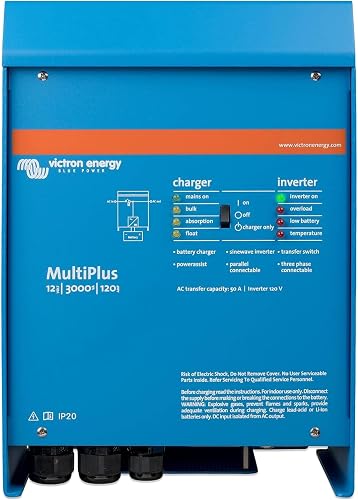
Victron Energy MultiPlus Inverter/Charger 3000VA, 12V
Victron Energy
- 3000VA pure sine wave output from a 12V bank
- PowerAssist tops up a small shore or generator supply
- Ultra-fast automatic transfer switching
- The brand professional off-grid installers specify by default
- Deep ecosystem of monitoring and networking accessories
- 4.5★ from 280+ owners
Why we picked it: Victron is the name that comes up whenever someone who installs off-grid systems for a living is asked what they'd put in their own house. The MultiPlus does the usual three jobs, then adds PowerAssist — it blends battery power with a small shore or generator supply so a 15-amp hookup can run loads that would otherwise trip it. That, plus a monitoring ecosystem nothing else in this price range matches, is why it stays in service for a decade while cheaper units get replaced twice.
2. Best All-in-One: SUMRY Hybrid Solar Inverter Charger 3600W, 24V DC to 110V AC

SUMRY Hybrid Solar Inverter Charger 3600W, 24V DC to 110V AC
SUMRY
- 3,600W continuous from a 24V battery bank
- Inverter, battery charger, and solar controller in one chassis
- Automatic transfer between solar, battery, and grid or generator
- Removes a whole component from an off-grid build
- Live power-flow display shows where energy is going
- 4.7★ from 160+ owners, 200+ bought in the past month
Why we picked it: A hybrid inverter charger replaces three boxes — inverter, charger, and charge controller — with one, and every box you delete is a set of cables, a fuse, and a failure point you no longer own. At 3,600W it runs a serious off-grid cabin, and the automatic transfer between solar, battery, and generator means the system manages itself. It carries the highest owner rating of the three and is the cheapest route to a complete build.
3. Best for RV & Marine: Xantrex Freedom 458 Inverter/Charger

Xantrex Freedom 458 Inverter/Charger
Xantrex
- Long-running Xantrex Freedom series design
- Built for the vibration and damp of RV and marine service
- Integrated three-stage charger and transfer switching
- Drops into standard 12V house-bank wiring
- A fixture in boats and coaches for years
- 4.6★ from 230+ owners
Why we picked it: RVs and boats are the hardest service an inverter charger sees — constant vibration, temperature swings, salt air, and a shore-power connection that gets plugged and unplugged hundreds of times a year. Xantrex has built for exactly that market long enough that the Freedom series is a known quantity to marine electricians, and the three-stage charger looks after a house bank properly rather than just dumping current into it. If the unit is going in something that moves, this is the safer bet.
Comparison Table
| Pick | Inverter Charger | Output | Battery | Best for |
|---|---|---|---|---|
| Best Overall | Victron MultiPlus 3000VA | 3000VA | 12V | Serious off-grid systems |
| Best All-in-One | SUMRY 3600W Hybrid | 3,600W | 24V | Simplifying a new build |
| Best for RV & Marine | Xantrex Freedom 458 | Freedom 458 | 12V | RV, van, and marine |
What to Look For in an Inverter Charger
Pure sine wave, not modified. Modified sine wave is cheaper and will run a resistive heater or an incandescent bulb, but it makes motors run hot, causes buzzing in audio gear, and can damage sensitive electronics and some medical equipment. Every pick here is pure sine wave. In 2026 there is no good reason to buy anything else for a system you live with.
Surge rating vs. continuous rating. Continuous output is what the unit sustains; surge is the brief peak it can deliver. Motors — well pumps, refrigeration compressors, air compressors, table saws — draw several times their running load at startup. Size continuous output to your total running load and surge to your single largest motor, or you'll be listening to a fault alarm at the worst moment.
Transfer switch speed. The built-in transfer switch is the defining feature. Speeds range from around 10ms to 30ms; anything in that range is fast enough that a laptop or router won't notice. Faster matters only for genuinely sensitive equipment — for most households, any built-in transfer is a large upgrade over doing it manually.
Charger amperage and battery type. Check the charge current and confirm the unit has a LiFePO4 charge profile if that's your chemistry — lead-acid profiles will undercharge lithium and shorten its life. Match the DC voltage to your bank as well: a 24V inverter charger will not work on a 12V system, and stepping a bank up to 24V is a rewiring job, not a setting.
Hybrid units with a built-in solar controller. If you're starting from scratch, a hybrid inverter charger that includes an MPPT controller removes a whole component from the build. If you already own a good charge controller, a plain inverter charger is the cheaper path — no sense paying twice for the same function.
Bottom Line: Which Should You Buy?
For a system you'll keep: the Victron MultiPlus 3000VA. The installer's default, with PowerAssist and monitoring nothing else matches.
For the simplest build: the SUMRY 3600W Hybrid. Inverter, charger, and MPPT in one box at the best rating here.
For anything that moves: the Xantrex Freedom 458. Marine-grade build and a three-stage charger that treats the bank properly.
Ready to buy?
Jump straight to our top picks on Amazon — prices shown at click-through.
Frequently Asked Questions
What is the best inverter charger in 2026?
The Victron MultiPlus 3000VA is our best overall pick for 2026. The SUMRY 3600W Hybrid and the Xantrex Freedom 458 cover the other cases this guide compares. See the comparison table below for specifications and owner ratings, then choose the one that matches your setup.
What is an inverter charger?
It's a single unit that combines three functions: a DC-to-AC inverter that powers household loads from your battery, a battery charger that refills the bank from shore power or a generator, and an automatic transfer switch that swaps between the two. A plain inverter only does the first job, which means adding a separate charger and switching by hand.
What's the difference between an inverter and an inverter charger?
An inverter converts battery power to AC and stops there. An inverter charger also recharges the battery from an external AC source and switches automatically between battery power and shore or generator power. For any system that gets recharged from something other than solar, the inverter charger saves you two components and a lot of manual switching.
What size inverter charger do I need?
Add up everything you'd run at once for continuous wattage, then check your largest motor's startup surge separately. A cabin running lights, a fridge, and a laptop might need 1,500W continuous; add a well pump and you want 3,000W continuous with real surge headroom. Sizing to peak-everything-at-once is expensive — sizing to realistic simultaneous load plus your biggest motor is the practical approach.
Can an inverter charger run a well pump?
Yes, if the surge rating is high enough. Well pumps draw three to five times their running wattage at startup — a 1HP pump drawing 800W running may spike past 3,000W for a moment. Match the inverter's surge rating against that spike, not against the running figure, and give yourself margin.
Do inverter chargers work with LiFePO4 batteries?
Most modern units do, but you must confirm the charger has a LiFePO4 profile rather than only lead-acid settings. Lead-acid profiles use different voltage setpoints and will chronically undercharge a lithium bank, costing you capacity and cycle life. If you're pairing one with the batteries in our solar battery bank guide, check the charge profile list before ordering.
Related Guides


How We Research
Picks are based on manufacturer specifications, current Amazon availability, and patterns across verified owner reviews. Inverter chargers are a smaller category than most off-grid gear, so we weighted established brand track record alongside review volume — confirm current specifications, battery voltage, and LiFePO4 charge profile support at the retailer before buying.
Safety note: Inverter chargers connect to both battery DC and household AC and must be installed with correctly sized cable, fusing, and grounding. Have permanent installations wired by a qualified electrician, and never connect an inverter's AC output to house circuits without a proper transfer device.