 Exploring
The ARCCAPTAIN MIG200 is the best MIG welder for most shops — a 200A 6-in-1 that grows with your skills. The YESWELDER 135A is the proven budget flux-core gateway, and the Hobart Handler 125 is the brand-name buy-once machine.
How We Picked
We compared amperage range, gas vs. flux-core capability, duty cycle, 110/220V flexibility, and owner learning-curve reports across MIG and multiprocess welders. A welder anchors the repair bench alongside our air compressor and angle grinder picks — and every welding bench needs the grinder for prep and cleanup. Off-grid, pair amperage-hungry tools with a generator that can carry them.
1. Best Overall: ARCCAPTAIN MIG200 200A 6-in-1 MIG Welder
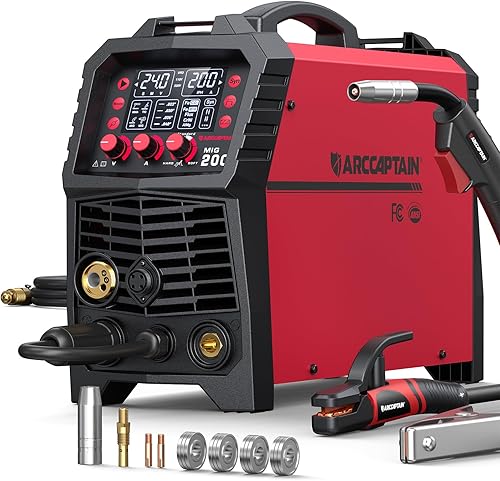
ARCCAPTAIN MIG200 200A 6-in-1 MIG Welder
ARCCAPTAIN
- 6-in-1: gas MIG, gasless flux core, stick, lift TIG & more
- Full 200A on 220V; runs 110V for household outlets
- Synergic controls set wire speed automatically
- Welds aluminum with spool-gun support
- 4.6★ from 950+ owners
Why we picked it: The MIG200 is the machine you don't outgrow: start on gasless flux core the day it arrives, add a gas bottle for clean MIG later, borrow its stick mode for windy outdoor repairs, and its dual-voltage design follows you from garage outlet to shop subpanel. The synergic display removes the wire-speed guesswork that frustrates beginners. At 4.6 stars across nearly a thousand owners, it's the standout all-rounder.
2. Best Value: YESWELDER 135A Flux Core MIG Welder

YESWELDER 135A Flux Core MIG Welder
YESWELDER
- 3-in-1: gasless MIG, lift TIG, and stick
- Runs on any 110V household outlet
- No gas bottle needed — flux core wire only
- Light enough to carry to the repair
- 4.4★ from 2,900+ owners
Why we picked it: Three thousand owners have made this the internet's default first welder, and the formula is obvious: plug into any wall outlet, load flux-core wire, and you're welding 1/8-inch steel with no gas bottle, no regulator, no setup beyond a helmet. It won't lay the cosmetic beads a gas MIG will, but for fences, brackets, and farm repairs, it simply gets metal stuck together for the price of a cordless drill.
3. Best Brand-Name: Hobart Handler 125 Flux-Core Wire Feed Welder

Hobart Handler 125 Flux-Core Wire Feed Welder
Hobart
- Hobart build quality with US-based support
- 25–130A output welds up to 1/8" steel
- Industrial-grade cast-aluminum wire drive
- 5-year/3-year/1-year tiered warranty
- 4.8★ owner rating
Why we picked it: Hobart is the name farm shops have trusted for a century, and the Handler 125 is the accessible end of that line: a cast-aluminum wire drive where budget machines use plastic, a transformer that shrugs off duty-cycle abuse, and a real tiered warranty behind it. Owners rate it a near-perfect 4.8. If you'd rather buy one welder for the next twenty years than upgrade twice, this is that machine.
Comparison Table
| Pick | Welder | Output | Power | Best for |
|---|---|---|---|---|
| Best Overall | ARCCAPTAIN MIG200 | 200A, 6-in-1 | 110/220V | Growing skills & full shops |
| Best Value | YESWELDER 135A | 135A, 3-in-1 | 110V | First welder, farm repairs |
| Best Brand-Name | Hobart Handler 125 | 130A flux-core | 115V | Buy-once reliability |
What to Look For in a MIG Welder
Gas MIG vs. gasless flux core. True MIG uses shielding gas for clean, low-spatter beads on prepared steel — ideal in a shop. Flux-core wire makes its own shielding, tolerates wind and grime, and needs no bottle: the right starting point for outdoor and farm work. Machines like the MIG200 do both, which is the practical answer.
Amperage and thickness. Figure roughly 1 amp per 0.001" of steel: 135A handles 1/8", 200A reaches 1/4" in a single pass. Multi-pass technique stretches small machines further, but if trailer frames and thick brackets are in your future, buy the 200A class once.
110V vs. 220V. 110V machines weld anywhere there's an outlet but top out around 140A. Dual-voltage inverters give you household convenience now and full power when you wire a 220V circuit — the flexibility that makes the ARCCAPTAIN the safer long-term buy.
Duty cycle honesty. A "200A" machine that runs 200A for 2 minutes in 10 is a different tool than one holding 60% duty. Hobby welding rarely hits limits, but long fence-rail beads will — check duty-cycle specs at the amperage you'll actually use, and let inverters rest when the thermal light says so.
Bottom Line: Which Should You Buy?
For most shops: the ARCCAPTAIN MIG200. Six processes, two voltages, one machine.
For a first welder: the YESWELDER 135A. Plug in, load wire, fix the gate.
For decades of service: the Hobart Handler 125. The brand farm shops hand down.
Ready to buy?
Jump straight to our top picks on Amazon — prices shown at click-through.
Frequently Asked Questions
What is the best MIG welder in 2026?
The ARCCAPTAIN MIG200 is our best overall pick for 2026. The YESWELDER 135A and the Hobart Handler 125 cover the other cases this guide compares. See the comparison table below for specifications and owner ratings, then choose the one that matches your setup.
What's the difference between MIG, TIG, and stick welding?
MIG feeds a wire electrode automatically — fastest to learn and the best all-rounder for steel repair. TIG uses a separate torch and filler rod for precise, beautiful welds on thin metal and aluminum, at a steep learning curve. Stick is the rugged outdoor process that burns through rust and wind. Multiprocess machines like the MIG200 let you use each where it shines.
Can a beginner learn MIG welding at home?
Yes — MIG (especially gasless flux core) is widely considered the most beginner-friendly process: pull the trigger, keep a steady angle and speed, and you'll lay serviceable beads within a weekend of practice on scrap. Auto-set/synergic machines remove most setup guesswork. Budget for a helmet, gloves, and jacket before the first arc.
Do I need gas for a MIG welder?
Not with flux-core wire, which shields its own puddle — that's how our YESWELDER and Hobart picks run bottle-free. Add a CO2/argon cylinder later for cleaner, low-spatter true-MIG beads on sheet metal and visible work. Outdoors in wind, flux core actually outperforms gas.
How thick of steel can a 110V welder handle?
A quality 110–140A machine welds up to about 1/8" in one pass, and 1/4" with beveling and multiple passes. For regular 1/4" single-pass work — trailer frames, thick brackets — step to a 200A-class dual-voltage machine on a 220V circuit.
What safety gear do I need to start welding?
Non-negotiables: an auto-darkening helmet, flame-resistant gloves and jacket, and closed-toe leather footwear — arc light burns skin and eyes in seconds. Weld away from anything flammable, ventilate fumes (never weld galvanized steel unprotected), and keep an extinguisher within reach. Sparks travel farther than you think.
Related Guides


How We Research
Picks are based on manufacturer specifications, current Amazon availability, and patterns across verified owner reviews. Output and duty-cycle figures are manufacturer ratings — confirm current details at the retailer before buying.
Safety note: Welding arc light causes eye damage in seconds — never strike an arc without a proper auto-darkening helmet, and shield bystanders. Ventilate fumes, clear flammables from a 35-ft radius, and never weld coated or galvanized steel without respiratory protection.