 Exploring
The Mekupc AX3000 Outdoor is the best RV WiFi booster for most rigs — WiFi 6, weatherproof, and the highest-rated of the three. The WAVLINK AX1800 IP67 is the value pick with the toughest weather sealing, and the WAVLINK AX3000 Outdoor Access Point reaches farthest when the source is a long way off.
How We Picked
We compared antenna gain and real range, WiFi standard and throughput, weatherproof ratings for permanent outdoor mounting, power-over-Ethernet support (one cable instead of two), and setup difficulty for people who don't configure networks for a living. This is the WiFi-hardware answer — if your problem is cellular rather than WiFi, see our cell phone signal booster guide, and for data plans and hotspots see our off-grid internet guide.
1. Best Overall: Mekupc AX3000 Outdoor WiFi 6 Extender and Access Point
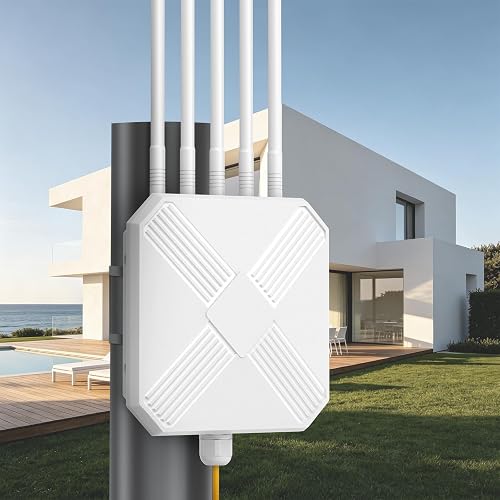
Mekupc AX3000 Outdoor WiFi 6 Extender and Access Point
Mekupc
- WiFi 6 (AX3000) with high-gain outdoor antennas
- Works as an extender or a standalone access point
- Weatherproof housing for permanent outdoor mounting
- Power over Ethernet — one cable does data and power
- Highest owner rating of the three picks here
- 4.5★ from 200+ owners, 200+ bought in the past month
Why we picked it: WiFi 6 matters more in a campground than at home, because campground WiFi's real problem isn't distance alone — it's fifty devices fighting over one access point. WiFi 6 handles congestion far better than the older standards most boosters still use. Add PoE, so a single Ethernet run carries both power and data out to the antenna, and a weatherproof body that can stay mounted, and this is the most complete package here. It also carries the best owner rating of the three.
2. Best Value: WAVLINK AX1800 Outdoor WiFi 6 Extender, IP67 Weatherproof
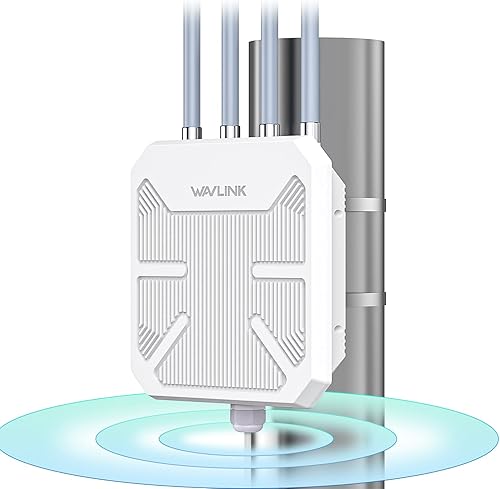
WAVLINK AX1800 Outdoor WiFi 6 Extender, IP67 Weatherproof
WAVLINK
- IP67 rated — sealed against dust and immersion
- WiFi 6 (AX1800) with long-range outdoor antennas
- Survives permanent mounting through winter
- Established brand in outdoor WiFi hardware
- Costs meaningfully less than AX3000 models
- 4.2★ from 400+ owners, 500+ bought in the past month
Why we picked it: IP67 is the highest weather rating in this group — dust-tight and sealed against temporary immersion — which is the spec that decides whether a booster survives being mounted on a ladder rail through a winter of freeze-thaw and road spray. AX1800 is a step down in headline throughput from AX3000, but campground internet is almost never fast enough for that to be the bottleneck. It's the most-bought unit here, and the sealing is why.
3. Best Range: WAVLINK AX3000 Outdoor WiFi 6 Extender and Access Point, Long Range

WAVLINK AX3000 Outdoor WiFi 6 Extender and Access Point, Long Range
WAVLINK
- AX3000 WiFi 6 with long-range directional gain
- Reaches access points several hundred feet away
- Doubles as an access point for a cabin or outbuilding
- Weatherproof body built for a mast or pole mount
- Aim it at the source for the strongest possible link
- 4.3★ from 270+ owners, 500+ bought in the past month
Why we picked it: When the campground router is genuinely far away — the far end of a big park, or a cabin's WiFi you're trying to reach from a pad down the hill — antenna gain does more than raw throughput. This unit is built for that: directional long-range gain you can aim at the source, in a body meant for a mast. It also works as a standalone access point, which makes it useful for pushing WiFi out to a barn, shop, or second cabin once you're back home.
Comparison Table
| Pick | Booster | Standard | Standout | Best for |
|---|---|---|---|---|
| Best Overall | Mekupc AX3000 Outdoor | AX3000 / WiFi 6 | PoE | Most rigs and cabins |
| Best Value | WAVLINK AX1800 IP67 | AX1800 / WiFi 6 | IP67 sealed | Year-round outdoor mounting |
| Best Range | WAVLINK AX3000 Access Point | AX3000 / WiFi 6 | Long-range gain | Distant access points |
What to Look For in an RV WiFi Booster
Outdoor beats indoor, every time. An RV's aluminum or fiberglass skin attenuates WiFi badly, so an indoor extender sitting on a shelf is already fighting the wall between it and the source. Mounting the radio outside — on a ladder, a pole, or a mast — routinely doubles usable range for the same hardware. This is the single most important choice here.
WiFi booster vs. cellular booster. These are completely different devices and buyers mix them up constantly. A WiFi booster amplifies an existing WiFi network — campground, marina, cabin. A cellular booster amplifies your carrier's signal for phone and hotspot data. If there is no WiFi network to grab, a WiFi booster has nothing to do.
Weatherproof rating. Anything mounted outside year-round should be IP65 at minimum, and IP67 if it will see road spray, coastal salt, or hard freeze-thaw cycles. This is the spec that determines whether the unit lasts three seasons or three years.
Power over Ethernet is worth seeking out. PoE carries power and data over one Ethernet cable, which means a single small hole through the wall instead of two — or an extension cord run outside. On an RV, where every penetration is a future leak, that simplification matters more than it does on a house.
Manage expectations about speed. A booster can only rebroadcast what it receives. If the campground has a slow connection shared among sixty rigs, a better antenna gets you a stable connection to a slow network — which is still a real improvement over a connection that keeps dropping, but it won't make it fast. For genuinely remote sites with no WiFi at all, satellite or cellular is the answer instead.
Bottom Line: Which Should You Buy?
For most rigs: the Mekupc AX3000 Outdoor. WiFi 6, PoE, and the strongest owner rating in the category.
For permanent outdoor mounting: the WAVLINK AX1800 IP67. IP67 sealing at a lower price, and throughput you won't actually miss.
For distant signals: the WAVLINK AX3000 Access Point. Directional gain you can aim, and it doubles as an outbuilding access point.
Ready to buy?
Jump straight to our top picks on Amazon — prices shown at click-through.
Frequently Asked Questions
What is the best RV WiFi booster in 2026?
The Mekupc AX3000 Outdoor is our best overall pick for 2026. The WAVLINK AX1800 IP67 and the WAVLINK AX3000 Access Point cover the other cases this guide compares. See the comparison table below for specifications and owner ratings, then choose the one that matches your setup.
What is an RV WiFi booster?
It's a device — usually an outdoor-mounted antenna and radio — that picks up a weak WiFi signal from a campground, marina, or nearby building and rebroadcasts it as a strong network inside your rig. It doesn't create internet; it grabs an existing network you'd otherwise be too far from or too shielded to use reliably.
Do RV WiFi boosters actually work?
Yes, when the underlying problem is distance or obstruction rather than bandwidth. A good outdoor booster routinely turns a signal that drops constantly into a stable connection. What it cannot do is speed up a campground connection that's genuinely saturated — if sixty rigs are sharing one slow line, a better antenna gets you a reliable slow connection, not a fast one.
What's the difference between an RV WiFi booster and a cellular booster?
A WiFi booster amplifies an existing WiFi network, so it needs a network in range to work. A cellular booster amplifies your mobile carrier's signal, improving phone calls and hotspot data — useful where there's cell coverage but no WiFi at all. Many full-timers carry both, since which one saves the day depends entirely on where they parked.
Where should I mount an RV WiFi booster?
As high and as unobstructed as possible — a ladder mount, a pole, or a mast on the roof. Height and clear line of sight toward the source access point matter far more than the exact position, and getting the radio outside the rig's metal skin is the biggest single gain available to you.
Can I use an RV WiFi extender at a cabin or homestead?
Absolutely, and it's one of the better uses for one. The same hardware pushes WiFi from a house out to a barn, shop, or second cabin hundreds of feet away — far cheaper than trenching Ethernet. All three picks here work as standalone access points as well as extenders, which is exactly what that job needs.
Related Guides


How We Research
Picks are based on manufacturer specifications, current Amazon availability, and patterns across verified owner reviews. Range and throughput figures are manufacturer ratings under ideal conditions — real-world results depend heavily on the source network, distance, and obstructions.
Safety note: Mount outdoor antennas clear of overhead power lines, and never work on a ladder or RV roof alone. Check the rig's total height after adding a mast — low bridges and overhanging branches account for most RV antenna losses.