 Exploring
The iSpring WSP-50 spin down is the best sediment filter for well water with sand or grit — flush it instead of replacing it. Follow it with the SimPure Big Blue housing for whole-house polishing, and load that housing with the Pentek DGD-5005 dual-gradient cartridge on a silty well.
How We Picked
Sediment filtration is a two-stage problem on most wells: something reusable to take out the heavy grit, then a cartridge to polish. We compared products on the micron rating and whether it is nominal or absolute, port size and rated flow (a whole-house filter must not throttle a 1-inch line), whether the media is flushable or disposable, how the housing opens, and what owners on real well water say about pressure drop and change intervals. We chose one product for each role rather than three near-identical housings, so the three picks together are a complete system. If you are also dealing with iron, hardness or bacteria, our whole house water filter and water softener guides cover the next stages.
1. Best Overall: iSpring WSP-50 Spin Down Sediment Filter — Reusable Whole House Prefilter, 50 Micron

iSpring WSP-50 Spin Down Sediment Filter — Reusable Whole House Prefilter, 50 Micron
iSpring
- Reusable stainless steel 50-micron screen — flush it, never replace it
- 1" MNPT and 3/4" FNPT ports; rated to 20 GPM
- Clear housing shows when it needs a flush
- Protects the rest of the system from sand and grit
- 4.6★ from 3,603 owners
Why we picked it: For a well with sand, silt or rust flakes, the first filter in line should be one you flush rather than replace, and the iSpring WSP-50 is the spin down sediment filter that most well owners settle on. Water enters the clear bowl, heavier particles spin out to the bottom and a stainless mesh catches the rest; open the valve at the base for a few seconds and the bowl flushes clean. Nothing to buy again. At 50 microns it catches the material that would blind a cartridge in a week and leaves the fine polishing to a cartridge downstream. The 1-inch ports and 20 GPM rating mean it does not choke a whole-house line, and the clear housing tells you at a glance when it is time to flush. It is the best sediment filter for well water where the problem is grit rather than cloudiness.
iSpring makes the same body with 100-, 200- and 500-micron screens for coarser sand, and a jumbo WSP50ARB for very heavy loads. On city water with little sediment, skip it and go straight to a cartridge.
2. Best Whole House: SimPure DB10P 10" x 4.5" Whole House Sediment Water Filter Housing with Gauge, Bracket, Wrench and 5-Micron Cartridge

SimPure DB10P 10" x 4.5" Whole House Sediment Water Filter Housing with Gauge, Bracket, Wrench and 5-Micron Cartridge
SimPure
- Standard 10" x 4.5" Big Blue housing — takes any brand's cartridges
- 1" ports for whole-house flow; built-in pressure gauge
- Ships with bracket, wrench and a 5-micron cartridge
- Pressure release button makes changes painless
- 4.4★ from 3,040 owners
Why we picked it: A whole house sediment filter is really a housing plus whatever cartridge you decide to run, and the SimPure DB10P is the complete kit: the standard Big Blue size, 1-inch ports so it does not restrict a whole-house line, a pressure gauge on the head so you can see the cartridge loading up, and the bracket, wrench and first 5 micron sediment filter in the box. Because it is the standard 10 x 4.5 format, replacement cartridges from Pentair, iSpring, Culligan or anyone else fit, which is what makes it the value pick over proprietary housings. Owners' notes cluster on two things: use the pressure-release button before opening it, and put a shut-off valve on each side. Do both and it is a fit-and-forget install.
Run it after a spin-down on a well, or on its own on municipal water. For iron and manganese on a well you need a dedicated system, not a sediment cartridge — see our whole house water filter guide.
3. Best Cartridge for Well Water: Pentair Pentek DGD-5005 Big Blue Whole House Sediment Filter Cartridge — Dual-Gradient 50/5 Micron
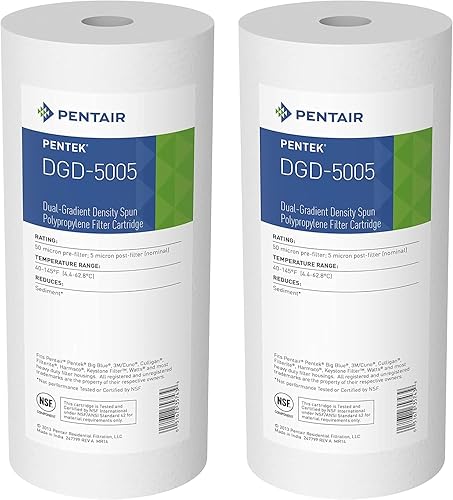
Pentair Pentek DGD-5005 Big Blue Whole House Sediment Filter Cartridge — Dual-Gradient 50/5 Micron
Pentair
- Dual-gradient polypropylene: 50 micron outer layer, 5 micron core
- Fits any 10" x 4.5" Big Blue housing
- Holds far more dirt than a single-density cartridge
- Rated to 20 GPM with low pressure drop
- 4.7★ from 1,793 owners
Why we picked it: The cartridge that goes inside the Big Blue housing matters as much as the housing, and on a well the Pentek DGD-5005 is the one to buy. It is a dual-gradient cartridge: the outer layer is 50 microns and catches the coarse material, the core is 5 microns and does the fine work, so it loads from the outside in and lasts far longer than a plain 5-micron cartridge that clogs on its surface. Pentair is the name in residential filtration and the DGD series is what plumbers spec for wells. It fits the SimPure housing above or any standard Big Blue, and owners on sandy or silty wells report months between changes where a plain cartridge lasted weeks.
On very clean water a 5-micron single-density cartridge is cheaper and fine; the DGD earns its price where there is real sediment.
Comparison Table
| Pick | Product | Type | Rating | Key details | Best for |
|---|---|---|---|---|---|
| Best Overall | iSpring WSP-50 Spin Down | Spin-down (reusable) | 50 micron | 1" ports, 20 GPM, flush valve | Wells with sand, grit, rust flakes |
| Best Whole House | SimPure DB10P Big Blue Housing | Big Blue cartridge housing | Any 10" x 4.5" cartridge | 1" ports, gauge, wrench, bracket | Whole-house polishing, city or well |
| Best Cartridge for Well Water | Pentair Pentek DGD-5005 | Replacement cartridge | 50 → 5 micron gradient | 10" x 4.5", 20 GPM | Silty or sandy wells, long cartridge life |
Micron Ratings Explained: Which Sediment Filter Do You Need?
A micron is a thousandth of a millimetre; a human hair is about 70 microns. A sediment filter's micron rating is the particle size it catches, and the right number depends on what your water is carrying.
| Micron rating | Catches | Where it belongs |
|---|---|---|
| 100–500 | Coarse sand, grit, scale flakes | First spin-down on a sandy well |
| 50 | Fine sand, rust flakes, most visible particles | Spin-down prefilter — our top pick |
| 20–30 | Silt, fine rust | Single cartridge on a moderately dirty well |
| 5 | Fine silt, turbidity, protects RO and UV | Whole-house cartridge or final stage |
| 1 | Very fine particles, some cysts (if absolute-rated) | Before UV or reverse osmosis only |
Coarse to fine. Filters go in order from the largest micron rating to the smallest. A 5-micron cartridge placed first on a sandy well clogs in days; put the 50-micron spin-down ahead of it and the cartridge lasts months.
Nominal versus absolute. Most sediment filters are nominally rated — they catch most particles of that size. Absolute ratings (guaranteed) matter only when the filter is protecting a UV steriliser or removing cysts; for keeping grit out of a house, nominal is fine.
Do not go finer than you need. Every step down in micron rating costs pressure and cartridge life. If the water runs clear after a 20-micron cartridge, that is the right cartridge.
Where to Install a Sediment Filter on a Well System
After the pressure tank. The usual place is on the main line just after the pressure tank and before the softener, water heater or any other treatment. Filtering after the tank means the pump and the tank's bladder see full flow and the filter sees steady pressure rather than pump cycling.
Order of stages. Spin-down first, then the cartridge housing, then softener or iron filter, then any carbon, UV or reverse osmosis. Each stage protects the next.
Shut-offs and a bypass. A ball valve on each side of every housing, and ideally a bypass loop, so you can change a cartridge without draining the house. This is the single most common regret in owner reviews of cartridge housings.
Pressure gauges. A gauge before and after the cartridge (or the one built into the SimPure head plus one upstream) tells you when to change it: a 10–15 psi drop across the filter means it is loaded. Guessing by the calendar wastes cartridges or starves the house.
Flushing a spin-down. Open the flush valve at the bottom for a few seconds with a bucket underneath, weekly on a sandy well and monthly on a clean one. The clear bowl shows you when.
Freezing: Filter housings full of water crack if they freeze. In an unheated pump house, insulate them or install them inside the conditioned space.
Cartridge Life, Pressure Drop and Troubleshooting
A whole-house cartridge on a clean municipal supply lasts six months or more; on a silty well a plain 5-micron cartridge can load up in three weeks, which is the case for a dual-gradient cartridge that holds several times the dirt. Watch the gauge rather than the calendar. If pressure at the taps falls and the gauge upstream of the filter is normal, the cartridge is the problem; if both are low, look at the pressure switch and tank first.
Discoloured water that a sediment filter does not clear is usually dissolved iron or manganese, which passes straight through a sediment cartridge and needs an oxidising iron filter. Cloudy water that settles in a glass is fine sediment and wants a smaller micron rating. A sulphur smell is a different problem again — see our whole house water filter guide for those.
Finally, a spin-down that fills with sand every few days is telling you something about the well: a failing screen, a pump set too low, or a well that needs developing. The filter is protecting the house; the cause is at the well.
What to Look For
Reusable or cartridge. Spin-down for grit you can flush away; cartridge for fine silt and polishing. Most wells want one of each.
Port size and flow. 1-inch ports and a 20 GPM rating for a whole-house line. 3/4-inch housings restrict flow in a larger house.
Standard cartridge size. 10 x 4.5 inch Big Blue (or 20 x 4.5 for higher flow) so any brand's cartridge fits and you are not locked in.
Micron rating. 50 for the prefilter, 5 for the polishing cartridge, dual-gradient where sediment is heavy.
Pressure gauge and release. A gauge to tell you when to change it, and a release button so the housing opens without a fight.
Clear housing. On a spin-down, a clear bowl is the maintenance indicator. On a cartridge housing, opaque is fine and blocks algae.
Bottom Line: Which Should You Buy?
For a well with grit: the iSpring WSP-50 Spin Down. The reusable spin-down that catches sand and rust flakes and flushes clean in seconds.
Whole-house polishing: the SimPure DB10P Big Blue Housing. A standard Big Blue housing with 1-inch ports, a gauge and everything needed to install it.
Load it with: the Pentair Pentek DGD-5005. The dual-gradient cartridge that lasts months on a silty well where a plain cartridge lasts weeks.
Ready to buy?
Jump straight to our top picks on Amazon — prices shown at click-through.
Frequently Asked Questions
What is the best sediment filter for well water?
For grit and sand, a reusable spin-down like the iSpring WSP-50 as the first stage; for fine silt, a Big Blue cartridge housing loaded with a dual-gradient cartridge such as the Pentek DGD-5005. Most wells with visible sediment want both, in that order.
What micron sediment filter should I use?
Fifty microns for a spin-down prefilter, then 5 microns for a whole-house cartridge. Use 20–30 microns as a single cartridge on a moderately dirty well, and 1 micron only ahead of UV or reverse osmosis. Finer than necessary just costs pressure and cartridge life.
Where should a sediment filter be installed?
On the main line after the pressure tank and before the softener, water heater and any other treatment, with a shut-off valve on each side. On a well, the spin-down goes first and the cartridge housing after it.
How often should I change a sediment filter?
When the pressure drop across it reaches 10–15 psi, or when flow at the taps falls. On clean water that is six months or more; on a silty well a plain cartridge can need changing monthly, which is why a dual-gradient cartridge is worth it. A spin-down is flushed rather than changed.
Will a sediment filter fix rusty or brown water?
It removes rust flakes and particles, but dissolved iron passes straight through and needs an iron filter. If the water is clear from the tap and turns brown in the glass, it is dissolved iron; if it is brown from the tap and settles, a sediment filter helps.
Spin down or cartridge sediment filter — which is better?
They do different jobs. A spin-down catches coarse material and is flushed, never replaced, so it is ideal first on a sandy well. A cartridge catches fine silt and turbidity and must be replaced. On most wells the right answer is a spin-down feeding a cartridge housing.
Related Guides


How We Research
Picks are based on manufacturer specifications, current Amazon availability, and patterns across verified owner reviews. Specs, capacities, and included accessories vary by listing — confirm the current details at the retailer before buying.
Note: Sediment filters remove particles only — they do not treat dissolved iron, hardness, bacteria or chemical contaminants. Have well water tested and add the appropriate stage for anything the test finds. Install filter housings where they cannot freeze.