 Exploring
For a cabin or family, the CAMPLUX F10 (2.64 GPM) delivers enough hot water for a real shower and sink. For solo use, a camp, or tight space, the CAMPLUX F5 (1.32 GPM) is lighter and uses less gas. Flow rate is the deciding factor.
How We Picked
We compared flow rate (GPM), temperature control, ignition, portability, and gas use — what determines whether you get a satisfying off-grid shower. Both ignite on D-cell batteries (no grid power) and run on propane. Pair one with our propane appliance setup.
1. Best for Cabins/Families: CAMPLUX F10 Ultra 2.64 GPM Thermostatic Tankless Heater
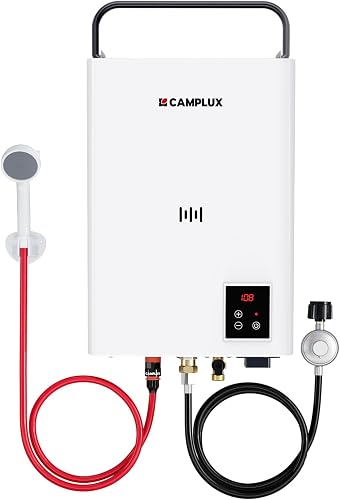
CAMPLUX F10 Ultra 2.64 GPM Thermostatic Tankless Heater
CAMPLUX
- Higher 2.64 GPM hot-water flow
- Thermostatic temperature control
- Battery ignition — no electricity to heat
- Enough for a real shower and sink
- Well-rated at 4.3★
Why we picked it: The F10's higher 2.64 GPM flow is what makes an off-grid shower actually enjoyable, and thermostatic control holds your set temperature. The pick for a cabin or anyone who wants household-style hot water. Best for cabins and families.
2. Best for Solo & Portability: CAMPLUX F5 Ultra 1.32 GPM Thermostatic Tankless Heater

CAMPLUX F5 Ultra 1.32 GPM Thermostatic Tankless Heater
CAMPLUX
- Compact 1.32 GPM design
- Thermostatic temperature control
- Battery ignition, propane powered
- Lighter and uses less gas
- Solid 4.3★ rating
Why we picked it: The F5 trades flow for portability — lighter, more gas-efficient, and easier to pack for a camp, a solo cabin, or quick washing up. When you don't need full-shower flow, it's the smarter, leaner choice. Best for solo use and portability.
Looking for the gear itself? See our top tankless water heaters →
Comparison Table
| Pick | Heater | Flow | Control | Best for |
|---|---|---|---|---|
| Cabins/Families | CAMPLUX F10 | 2.64 GPM | Thermostatic | Showers & sinks |
| Solo/Portable | CAMPLUX F5 | 1.32 GPM | Thermostatic | Camps & solo use |
Flow Rate vs Temperature Rise: Reading the Real Numbers
A tankless heater's advertised GPM is at a modest temperature rise. What it delivers depends on how cold the water arrives and how hot you want it. The two CAMPLUX units make that trade-off visible:
| Incoming water | Rise to 105°F shower | CAMPLUX F10 (2.64 GPM rated) | CAMPLUX F5 (1.32 GPM rated) |
|---|---|---|---|
| 70°F (summer, warm climate) | 35°F | ~2.6 GPM — full shower + sink | ~1.3 GPM — one good shower |
| 55°F (spring/fall, groundwater) | 50°F | ~1.8 GPM — one strong shower | ~0.9 GPM — a low-flow shower |
| 40°F (winter, northern well) | 65°F | ~1.4 GPM — one shower, modest flow | ~0.7 GPM — a trickle |
So in winter on a northern well, the F10 is a one-shower heater and the F5 is a hand-washing heater. If you are choosing for year-round cabin use in a cold climate, the larger unit is not an upgrade — it is the minimum. In a warm climate or for summer camp use, the F5's portability is the better trade.
Low-flow shower heads help more than anything. A 1.5 GPM head instead of a 2.5 GPM head is the difference between a hot shower and a lukewarm one on a small heater, and it halves propane use. See our camping shower picks for pump-and-head kits that pair with either unit.
Installation, Venting and Propane Supply
Outdoors, or vented. Both units are outdoor-rated portable heaters. Running one indoors without a proper vent is a carbon-monoxide risk; the safe indoor option is a purpose-built vented tankless heater, which is a different product. Mount these under an eave or in an open-sided wash house, protected from direct rain.
Water pressure. These heaters need 2.5–3 PSI minimum to open the gas valve and work best above 20 PSI. On a gravity tank system they will not fire; add a 12V pump or a small booster. On a well or municipal supply, they are fine.
Propane supply. The F10 draws about 68,000 BTU/hr at full output — roughly 0.75 lb of propane an hour, so a 20 lb cylinder gives around 25 hours of hot water. The F5 is about half that. Use the regulator supplied with the heater and a hose rated for it; a barbecue regulator is a different pressure. In cold weather a small cylinder can frost and lose pressure under heavy draw — a 30 or 40 lb tank fixes that.
Ignition power. Both ignite from two D-cell batteries, so there is no mains dependence — which is why they suit off-grid. Replace the batteries each season.
Freeze protection. Drain the heater after use in freezing weather: unscrew the inlet, tip it, and let the heat exchanger empty. A split exchanger is the most common failure and it is not covered by warranty.
Scale. Hard well water scales the heat exchanger and the unit gradually loses output. A sediment filter on the inlet and a vinegar flush every season keeps it working; a whole-house softener is overkill for a cabin but a small inline scale inhibitor is not.
What to Look For
Flow rate (GPM). Higher GPM means a stronger, warmer shower; lower GPM is fine for washing up and uses less propane.
Temperature control. Thermostatic models hold a set temperature instead of drifting — far more comfortable for showering.
Ignition power. Most portable units ignite on D-cell batteries, so they heat with no grid power — check what it needs.
Portability & gas use. Smaller heaters pack easier and sip less propane; bigger ones deliver more hot water but weigh and burn more.
Bottom Line: Which Should You Buy?
For cabins and families: the CAMPLUX F10. Full-flow, shower-worthy hot water.
For solo use and travel: the CAMPLUX F5. Lighter, leaner, gas-efficient.
Made up your mind?
Each pick opens on Amazon, where the current price and stock are listed.
Frequently Asked Questions
How does a propane tankless water heater work?
It heats water on demand as it flows through, igniting a propane burner (usually with battery ignition) only when you open the hot tap — no tank or electricity to heat.
What flow rate do I need for a shower?
Around 1.5–2.6 GPM gives a comfortable shower; 2.64 GPM (like the F10) feels household-like, while 1.32 GPM (the F5) is fine for a modest shower or washing up.
Do propane tankless heaters need electricity?
No — most portable models ignite on D-cell batteries and run entirely on propane, which is exactly why they suit off-grid living.
Are tankless water heaters safe off-grid?
Yes, used correctly — they must be operated with proper ventilation and never run inside an enclosed space, since combustion produces carbon monoxide.
How much propane does a tankless heater use?
It only burns while you're running hot water, so a tank lasts a long time; higher-flow models use more gas per minute than compact ones.
Can I use a propane tankless water heater in winter?
Yes, with two caveats. Output drops sharply because the incoming water is colder — a 2.6 GPM heater becomes a 1.4 GPM heater on 40°F well water — so choose the larger unit for a cold climate. And the heater must be drained after each use or protected from freezing, because water left in the heat exchanger will split it.
How long will a 20 lb propane tank run a tankless water heater?
The CAMPLUX F10 uses about 0.75 lb of propane per hour at full output, so a 20 lb tank gives roughly 25 hours of continuous hot water — several weeks of showers for a couple. The smaller F5 roughly doubles that. Actual use is far less than continuous because the heater only burns while water flows.
Keep reading


How this guide was put together
This comparison is based on manufacturer specifications, current Amazon availability, and patterns across verified owner reviews. Flow rate, ignition, and dimensions vary by listing — confirm the current details at the retailer before buying.
Safety warning: Propane water heaters produce carbon monoxide and must be used outdoors or with proper ventilation — never inside an enclosed space. Follow the manufacturer's clearance and venting instructions and keep a CO alarm nearby.