 Exploring
The Victron Orion-XS 50A is the best DC to DC charger you can buy — compact, cool-running, and Bluetooth-configurable to any battery. The Victron Orion-Tr Smart 30A is the proven mid-size install, and the LiTime 40A is the value pick for lithium banks.
How We Picked
We compared charge amperage, efficiency and heat under sustained load, smart-alternator compatibility, lithium charge profiles, Bluetooth configurability, and owner reports from van and RV builds that live on these daily. A DC to DC charger is one of three ways into a house bank: solar through a charge controller, shore power through an inverter charger, and the alternator through one of these. Serious builds run at least two of the three.
1. Best Overall: Victron Energy Orion-XS Smart DC to DC Charger, 12/12V 50A
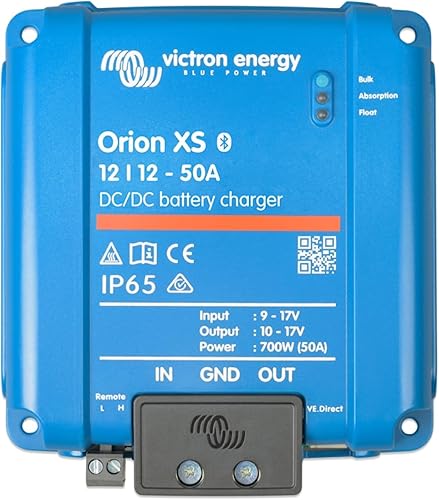
Victron Energy Orion-XS Smart DC to DC Charger, 12/12V 50A
Victron Energy
- 50 amps — a big lithium bank charges on a normal drive
- Remarkably compact and efficient; runs cool at full output
- Bluetooth setup and monitoring through the VictronConnect app
- Fully programmable for lithium, AGM, or custom profiles
- Works with smart alternators via engine-run detection
- 4.7★ from 520+ owners, 500+ bought in the past month
Why we picked it: The Orion-XS is the current state of the art: 50 amps from a box small enough to mount anywhere, with efficiency high enough that it doesn't need the bulky heatsinks of previous generations. Every parameter is adjustable over Bluetooth — charge voltages, input lockouts to protect your starter battery, engine-detection for smart alternators. At 50 amps, a couple of hours of driving puts real charge into even a 200Ah lithium bank. It's the charger the van-build community has standardized on, at 4.7 stars.
2. Best Proven Mid-Size: Victron Energy Orion-Tr Smart DC to DC Charger 12/12V 30A

Victron Energy Orion-Tr Smart DC to DC Charger 12/12V 30A
Victron Energy
- 30 amps — the right size for most single-battery banks
- Galvanically isolated design for clean, safe installs
- Years of field history in vans, boats, and RVs
- Bluetooth configuration via VictronConnect
- Engine-run detection for smart alternators
- 4.7★ from 880+ owners, 200+ bought in the past month
Why we picked it: The Orion-Tr Smart is the previous benchmark, and it remains the right buy for a lot of builds: 30 amps suits a 100-200Ah bank without demanding oversized cabling, and the isolated design keeps the vehicle and house electrical systems cleanly separated — something marine installers in particular insist on. It has the longest field record of anything in this guide at the same 4.7-star rating, and it's regularly cheaper than the XS. Proven is its own feature.
3. Best Value: LiTime 12V 40A DC-DC Lithium Battery Charger

LiTime 12V 40A DC-DC Lithium Battery Charger
LiTime
- 40 amps of lithium-correct 14.6V charging
- From the brand behind some of the best-selling LiFePO4 batteries
- M8 terminals take real cable for the current involved
- Simple install — no configuration required for LiFePO4
- Costs well under half of the premium options
- 4.4★ from early owners, 50+ bought in the past month
Why we picked it: LiTime earned its reputation making LiFePO4 batteries — including ones we've recommended on this site — and its DC to DC charger is tuned to exactly that chemistry: a fixed 14.6V lithium profile at a full 40 amps, no configuration needed. You give up the programmability and pedigree of the Victrons, and the review base is still young, but for a straightforward lithium bank on a budget the math is compelling. Note our full-transparency caveat: the Renogy alternatives we checked all rated below 4 stars, which is why a newer product from a proven battery brand takes this slot.
Comparison Table
| Pick | Charger | Output | Design | Best for |
|---|---|---|---|---|
| Best Overall | Victron Orion-XS 50A | 50A | Programmable | Lithium van and RV builds |
| Best Proven Mid-Size | Victron Orion-Tr Smart 30A | 30A | Isolated | Most single-bank installs |
| Best Value | LiTime 40A | 40A | LiFePO4-tuned | Budget lithium builds |
What to Look For in a DC to DC Charger
Why you can't just wire the batteries together. The old-school isolator simply parallels the start and house batteries, which worked — badly — with matched lead-acid. A lithium house bank connected directly to an alternator will pull every amp the alternator can make, overheating it, while never receiving the staged charge profile it needs. A DC to DC charger limits the draw to a safe, fixed rate and delivers a proper multi-stage charge. With lithium, it isn't optional.
Smart alternators make chargers mandatory too. Most vehicles built in the last decade use variable-voltage "smart" alternators that drop output when the ECU decides charging is done — leaving a directly-wired house battery chronically starved. DC to DC chargers with engine-run detection solve this cleanly, boosting whatever the alternator provides up to the correct charge voltage.
Size amperage to the bank and the alternator. A useful rule: charge current between 20% and 50% of your bank's amp-hour capacity — so a 100Ah battery is happy from 20 to 50 amps. Then confirm your alternator has headroom: pulling 50A continuously from a 120A alternator that also runs the vehicle is fine; doing it from an 90A unit in traffic on a hot day is not. When in doubt, size down — 30A charging on a long drive beats 50A charging that cooks an alternator.
Cable gauge is part of the product. Forty or fifty amps over a five-metre run demands seriously thick copper, correctly fused at both ends. Undersized cable wastes charge as heat and can be dangerous. Budget for proper cable, lugs, and fusing when you price the install — on a long run it can cost a meaningful fraction of the charger itself.
Solar-input combo units exist — decide if you want one. Some chargers combine a DC to DC stage with an MPPT solar input in one box, saving space in tight builds. The trade-off is the usual one for combo gear: one failure takes out both charge paths, and the built-in MPPT is rarely as good as a dedicated charge controller. In a van where space is everything, the combo can still be the right call.
Bottom Line: Which Should You Buy?
For lithium builds: the Victron Orion-XS 50A. Fifty cool-running amps and full app control — the community standard.
For most installs: the Victron Orion-Tr Smart 30A. The long-serving benchmark — isolated, proven, and 30 amps is usually enough.
For lithium on a budget: the LiTime 40A. Forty lithium-correct amps from a proven battery brand, at half the price.
Ready to buy?
Jump straight to our top picks on Amazon — prices shown at click-through.
Frequently Asked Questions
What is the best DC to DC charger in 2026?
The Victron Orion-XS 50A is our best overall pick for 2026. The Victron Orion-Tr Smart 30A and the LiTime 40A cover the other cases this guide compares. See the comparison table below for specifications and owner ratings, then choose the one that matches your setup.
What is a DC to DC charger?
It's a device that takes power from your vehicle's alternator (via the starter battery) and converts it into a proper multi-stage charge for a second "house" battery. It limits how much current the house bank can draw — protecting the alternator — while delivering the voltage profile the house battery's chemistry actually requires.
Do I need a DC to DC charger for a lithium battery?
Effectively yes, if you want to charge it from your alternator. Lithium batteries accept charge so aggressively that a direct connection can overload and overheat the alternator, and they need a charge profile an alternator alone doesn't provide. A DC to DC charger fixes both problems and is standard practice in every professional lithium install.
What size DC to DC charger do I need?
Aim for a charge rate of roughly 20-50% of your house bank's capacity: 20-30A for a 100Ah bank, 40-50A for 200Ah and up. Then sanity-check your alternator — the charger's draw plus the vehicle's own needs should sit comfortably inside its rating. Bigger banks on long drives justify 50A; occasional weekend use is fine at 30A.
Can a DC to DC charger work with solar at the same time?
Yes — this is the standard van and RV setup. Solar charges through its own controller while the DC to DC charger contributes whenever the engine runs; the house battery happily accepts both at once. Some units combine both functions in one box with a shared output, which saves space at the cost of redundancy.
Why is my second battery not charging while driving?
The usual suspects: a smart alternator dropping voltage once the starter battery is full, undersized or corroded cabling between the batteries, or a failed isolator relay. If your vehicle is newer than about 2015, the smart alternator is the most likely culprit — and a DC to DC charger with engine-run detection is the standard fix.
Related Guides


How We Research
Picks are based on manufacturer specifications, current Amazon availability, and patterns across verified owner reviews. We checked the Renogy DC-DC line and passed on it this round — every SKU rated between 3.2 and 3.9 stars. Confirm alternator capacity and cable sizing against the manufacturer's install guide before buying.
Safety note: High-current DC wiring must be correctly sized and fused at both ends — an unfused 50A cable run is a fire waiting for a chafe point. Disconnect batteries before working, and if you're not confident sizing cable and fuses, have an auto electrician do the install.