 Exploring
The Reliance Controls 31406CWK Pro/Tran is the best generator transfer switch for most homes — a six-circuit, pre-wired panel that's been the contractor default for years. The 100A double-throw safety switch is the value pick for whole-panel switching, and the Connecticut Electric Series 2 kit arrives with the cord and inlet box already in the carton.
How We Picked
We compared circuit count, amperage, whether the switch is pre-wired or requires field wiring, NEMA enclosure rating for outdoor use, watt metering, and long-term owner reports. We also separated the two real categories buyers confuse: circuit-level transfer switches that pick specific loads, and whole-panel double-throw switches that move the entire service. Pair whichever you choose with the right generator — see our portable generator picks — and if you're still deciding how to make the connection, read how to connect a generator to your house first.
1. Best Overall: Reliance Controls 31406CWK Pro/Tran 30-Amp 6-Circuit Transfer Switch

Reliance Controls 31406CWK Pro/Tran 30-Amp 6-Circuit Transfer Switch
Reliance Controls
- Pre-wired 6-circuit panel — no loose wiring to figure out
- 30 amps, 7,500 running watts
- Built-in watt meters show load on each leg
- Individual switches let you rotate circuits as needs change
- The manual transfer switch most electricians reach for first
- 4.7★ and an Amazon #1 Top Rated badge
Why we picked it: The Pro/Tran line is the reason "Reliance" is shorthand for transfer switch. It arrives pre-wired, so your electrician is landing six circuits rather than building a panel from scratch — which usually means a shorter, cheaper install. The watt meters are the underrated part: you can see exactly how loaded each leg is and shed something before the generator stalls. It is the safest default recommendation in the category.
2. Best Value: 100A Generator Transfer Switch, 24,000W Double-Throw Safety Switch

100A Generator Transfer Switch, 24,000W Double-Throw Safety Switch
General Duty
- 100 amps at 120/240V — 24,000 watts
- Double-throw design physically cannot bridge utility and generator
- NEMA 3R enclosure rated for outdoor mounting
- Switches the whole panel rather than selected circuits
- A fraction of the cost of a comparable branded switch
- 4.6★ from 360+ owners, 300+ bought in the past month
Why we picked it: If you own a large dual-fuel generator, a six-circuit panel wastes it. This double-throw safety switch moves your entire service between utility and generator for a small fraction of what branded whole-panel gear costs, and its mechanical design makes an unsafe position physically impossible. It needs a proper install — this is bare-bones industrial hardware, not a plug-and-play kit — but the value is hard to argue with, and the review volume says plenty of people have made it work.
3. Best Complete Kit: Connecticut Electric Series 2 Manual Transfer Switch Kit, 50 Amp 10 Circuit
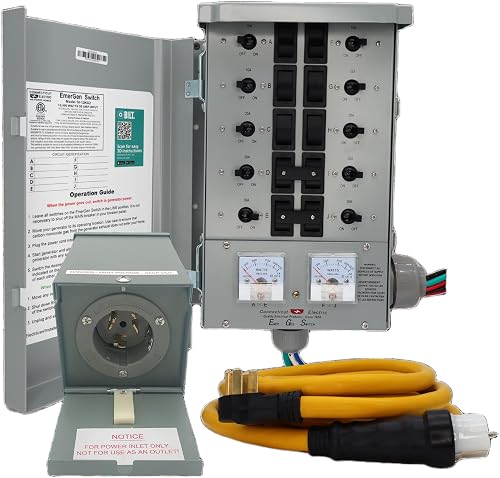
Connecticut Electric Series 2 Manual Transfer Switch Kit, 50 Amp 10 Circuit
Connecticut Electric
- 50 amps across 10 circuits
- Ships with a 25-foot generator cord in the box
- Includes an outdoor-rated 50A power inlet box
- Everything needed for the hookup in a single order
- Small-business brand with a long backup-power history
- 4.6★ from verified owners, 50+ bought in the past month
Why we picked it: The hidden cost of a transfer switch is everything that isn't the switch: the cord, the inlet box, the fittings — each ordered separately, each arriving on a different day, one of them wrong. This kit puts a ten-circuit 50A switch, a 25-foot cord, and an outdoor-rated inlet box in one carton. If you're handing the job to an electrician, handing over one box instead of a parts list is worth real money in labor.
Comparison Table
| Pick | Transfer Switch | Rating | Coverage | Best for |
|---|---|---|---|---|
| Best Overall | Reliance Controls 31406CWK | 30A / 7,500W | 6 circuits | Most homes with a portable generator |
| Best Value | 100A Double-Throw Transfer Switch | 100A / 24,000W | Whole panel | Big generators, small budgets |
| Best Complete Kit | Connecticut Electric Series 2 Kit | 50A | 10 circuits | One-order complete installs |
What to Look For in a Generator Transfer Switch
Manual vs. automatic transfer switch. A manual transfer switch costs a fraction of an automatic one and requires you to walk to the panel and flip it. An automatic transfer switch (ATS) senses the outage and starts the changeover itself — which matters if you travel, if you're keeping a sump pump or medical equipment alive, or if the house is a rental. For a portable generator you have to go outside and pull-start anyway, manual is usually the honest choice.
Circuit-level vs. whole-panel. Circuit-level switches like the Reliance Pro/Tran let you pick six or ten specific loads — furnace, fridge, well pump, a few outlets — and leave the rest dark. Whole-panel double-throw switches move the entire service and rely on you to manage load discipline. Circuit-level is more forgiving; whole-panel is more flexible if your generator is genuinely large.
Amperage and wattage headroom. Match the switch to the generator, not to the house. A 30A switch tops out around 7,500 running watts; a 50A switch around 12,500. Buying a switch smaller than your generator wastes capacity you paid for, and buying one larger than your generator is harmless but pointless.
Enclosure rating. Anything mounted outdoors needs a NEMA 3R enclosure at minimum. Indoor panels in a garage or basement can use a standard enclosure, but remember that the whole reason you're installing this is severe weather — err toward the weatherproof rating if there's any doubt about where it ends up.
What else you'll need. A transfer switch on its own doesn't finish the job. You'll also need a power inlet box on an exterior wall and a correctly-gauged generator cord to reach it. If your switch doesn't ship as a kit, order all three at once — see our generator hookup guide for how the pieces fit together.
Bottom Line: Which Should You Buy?
For most homes: the Reliance Controls 31406CWK. Pre-wired, metered, and the switch electricians install without being asked twice.
For whole-panel switching on a budget: the 100A Double-Throw Transfer Switch. 24,000 watts of capacity at a price that makes branded gear look silly.
For a one-order complete install: the Connecticut Electric Series 2 Kit. Ten circuits, cord, and inlet box together — nothing left to source.
Ready to buy?
Jump straight to our top picks on Amazon — prices shown at click-through.
Frequently Asked Questions
What is the best generator transfer switch in 2026?
The Reliance Controls 31406CWK is our best overall pick for 2026. The 100A Double-Throw Transfer Switch and the Connecticut Electric Series 2 Kit cover the other cases this guide compares. See the comparison table below for specifications and owner ratings, then choose the one that matches your setup.
What does a generator transfer switch do?
It disconnects your house from the utility grid before connecting it to your generator, so the two can never be joined. That protects utility line workers from your generator backfeeding the neighborhood, protects your generator from being destroyed when grid power returns, and lets you power hardwired circuits — furnace, well pump, lights — that extension cords can't reach.
Do I legally need a transfer switch to run a generator?
To connect a generator to your home's wiring, yes. The National Electrical Code requires a transfer device, and every jurisdiction in the US enforces some version of it. You can run appliances directly off the generator with cords without one, but the moment you want to power household circuits, a transfer switch (or an approved interlock kit) is mandatory.
What's the difference between a manual and automatic transfer switch?
A manual transfer switch requires you to physically flip it during an outage. An automatic transfer switch detects the loss of grid power, signals a standby generator to start, and switches over on its own — typically within seconds. Automatic switches cost considerably more and are normally paired with permanently installed standby generators rather than portable ones.
How many circuits do I need on my transfer switch?
Six circuits covers the classic essentials: furnace or boiler, refrigerator, well pump, a lighting circuit, and a couple of outlets. Ten circuits adds comfort — a second fridge or freezer, garage door, home office, a bathroom. Count your must-run loads first, then add one or two spares; retrofitting more circuits later costs more than buying them now.
Can I install a transfer switch myself?
Unless you're a licensed electrician, no. A transfer switch install means working inside a live service panel, and most jurisdictions require both a permit and an inspection. The switch itself is a modest cost next to the consequences of getting it wrong — hire it out, and keep the paperwork for your insurer.
Related Guides


How We Research
Picks are based on manufacturer specifications, current Amazon availability, and patterns across verified owner reviews. Amperage and wattage figures are manufacturer ratings — confirm compatibility with your generator and service panel before buying.
Safety note: Transfer switch installation means working in a live electrical panel and is licensed-electrician work in nearly every jurisdiction. Never connect a generator to house wiring without a transfer switch or approved interlock — backfeeding the utility line can kill line workers restoring power.