 Exploring
The Remington Solar 30 Watt is the best solar attic fan for most homes — the category's most-proven roof mount with a thermostat and humidistat included. The QuietCool AFR SLR-40 brings a bigger panel and an adjustable head for tricky roof angles, and the Remington 20 Watt covers smaller attics for less.
How We Picked
We compared airflow (CFM), panel wattage, thermostat and humidistat controls, hail and wind ratings, warranty length, and owner reports from multi-summer installs. A solar attic fan is passive-house thinking applied to cooling — it pairs naturally with the rest of a low-energy setup, from our evaporative cooler picks to the moisture control in our crawl space dehumidifier guide, which fights the same physics from the other end of the house.
1. Best Overall: Remington Solar 30 Watt Roof Mount Solar Attic Fan

Remington Solar 30 Watt Roof Mount Solar Attic Fan
Remington Solar
- 30W panel drives strong airflow through the peak heat hours
- Thermostat and humidistat included — runs only when needed
- Vents moisture in winter, not just heat in summer
- Quiet brushless motor
- The deepest owner record in the category
- 4.5★ from 440+ owners
Why we picked it: Remington Solar has been the name in this niche for years, and the 30-watt is its center-of-the-lineup pick for a reason: enough panel to keep the fan pulling hard through the hottest hours, with the thermostat and humidistat in the box rather than sold as add-ons. The humidistat matters more than buyers expect — winter attic moisture rots decking and breeds mold, and this fan vents it automatically. The longest track record here, at 4.5 stars.
2. Best Adjustable: QuietCool AFR SLR-40 Roof Mount Solar Attic Fan, 40 Watt

QuietCool AFR SLR-40 Roof Mount Solar Attic Fan, 40 Watt
QuietCool
- 40W adjustable panel tilts to face the sun properly
- More airflow headroom for larger or hotter attics
- QuietCool is the whole-house-fan specialist brand
- Adjustable head solves shaded or north-facing mounts
- Built for hot-climate duty
- 4.4★ from 260+ owners
Why we picked it: A fixed flat panel only makes full power when the sun cooperates, and plenty of roofs don't face the right way. The SLR-40's tilting 40-watt panel lets you aim at the sun's arc regardless of what the roofline dictates — often the difference between a fan that loafs and one that moves real air all afternoon. QuietCool built its reputation on whole-house ventilation, and that pedigree shows in the airflow figures.
3. Best Value: Remington Solar 20 Watt Roof Mount Solar Attic Fan, Round Series
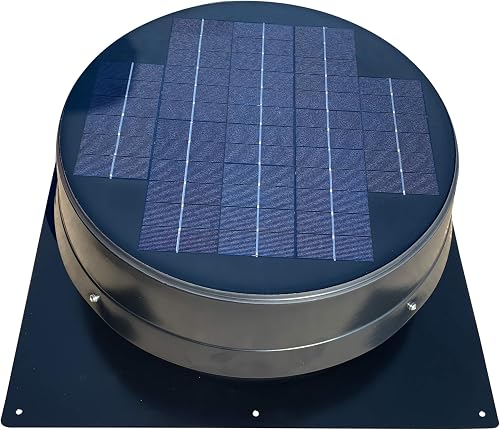
Remington Solar 20 Watt Roof Mount Solar Attic Fan, Round Series
Remington Solar
- 20W panel sized for smaller attics and outbuildings
- Same Remington build quality at the entry price
- Low-profile round housing looks tidy on the roof
- Thermostat-controlled operation
- Ideal for garages, sheds, and cabins too
- 4.5★ from 240+ owners
Why we picked it: Not every roof needs the big unit. For attics under roughly 1,200 square feet — or the detached garage, the shop, the cabin — the 20-watt Round Series delivers the same Remington reliability at a friendlier price, in a lower-profile housing that disappears against the shingles. It's also the natural pick for outbuildings on off-grid properties, where its zero-wiring install is worth as much as the airflow. Rated identically to its bigger sibling.
Comparison Table
| Pick | Fan | Panel | Standout | Best for |
|---|---|---|---|---|
| Best Overall | Remington Solar 30W | 30W | Thermostat + humidistat | Most attics up to ~2,000 sq ft |
| Best Adjustable | QuietCool AFR SLR-40 | 40W adjustable | Tilting panel | Big attics, imperfect roof angles |
| Best Value | Remington Solar 20W | 20W | Low-profile round | Smaller attics, garages, cabins |
What to Look For in a Solar Attic Fan
Why attic venting matters more than it sounds. A 150°F attic doesn't stay in the attic: it radiates through the ceiling all evening, forces your AC to fight an oven overhead, and bakes asphalt shingles from below — a known factor in premature roof aging. Active venting can pull attic temperatures down dramatically, which shows up in cooling bills and in how late the house stays hot.
Panel wattage is airflow when it counts. The fan moves the most air exactly when the panel makes the most power — the design's elegant self-timing. A 20W unit suits attics to roughly 1,200 sq ft; 30W covers most single-family homes; 40W+ or multiple fans for big footprints and hot climates. Undersizing shows up as an attic that's merely hot instead of scorching, which is progress but not the goal.
Thermostat and humidistat controls. A thermostat stops the fan from venting expensively-heated air in winter; a humidistat runs it when moisture builds even in cold months, protecting decking and insulation from condensation. Prefer units with both included — winter moisture is the failure mode nobody budgets for.
Intake venting is half the system. An attic fan can only exhaust what can flow in. If soffit vents are blocked by insulation or too few, the fan starves — or worse, pulls conditioned air up from the house through ceiling gaps. Check and clear your soffit venting before judging any fan's performance; it's the most common reason for disappointment in this category.
Fixed vs. adjustable panels, and the install itself. A fixed panel on a south-facing slope is perfect; on any other orientation, an adjustable panel recovers meaningful output. The install is a standard roof penetration — one fan, one hole, flashing under the shingles above. Comfortable DIYers do it in an afternoon; anyone else should pay a roofer rather than gamble a leak against the labor savings.
Bottom Line: Which Should You Buy?
For most homes: the Remington Solar 30W. The category's proven default, with the humidity control included.
For big attics and awkward roofs: the QuietCool AFR SLR-40. The tilting panel earns its premium the moment your roof faces the wrong way.
For smaller spaces: the Remington Solar 20W. Remington quality at the entry price — perfect for garages and cabins.
Made up your mind?
Each pick opens on Amazon, where the current price and stock are listed.
Frequently Asked Questions
What is the best solar attic fan in 2026?
The Remington Solar 30W is our best overall pick for 2026. The QuietCool AFR SLR-40 and the Remington Solar 20W cover the other cases this guide compares. See the comparison table below for specifications and owner ratings, then choose the one that matches your setup.
Do solar attic fans really work?
Yes — an appropriately sized solar attic fan meaningfully lowers peak attic temperature, which reduces the heat load radiating into living space and eases shingle aging from below. The effect is largest in hot climates with dark roofs and adequate soffit intake venting. They are a targeted fix for a real problem, not a whole-home cooling system.
How much does a solar attic fan lower attic temperature?
Typical well-matched installs report peak attic temperature drops in the range of 20-40°F versus an unvented or passively vented attic, with results depending on attic size, roof color, climate, and intake venting. The knock-on effect is a cooler ceiling, less evening heat soak, and an AC system that cycles less through the afternoon.
How many solar attic fans do I need?
One 30W-class fan handles most attics up to about 2,000 sq ft of floor area with decent intake venting. Larger homes, complex rooflines with separated attic bays, or brutal climates justify a second unit — two moderate fans spread across the roof usually beat one giant fan in a corner.
Do solar attic fans work on cloudy days or at night?
Output tracks sunlight, so cloudy-day airflow is reduced and night airflow is essentially nil — which aligns acceptably with need, since attic heat peaks with the sun. Some models accept an optional battery or hybrid power add-on for after-dark running, but for most homes the daylight-only cycle does the real work.
Can I install a solar attic fan myself?
A competent DIYer with roofing experience can — it's one hole, one flashing job, zero wiring, and manufacturers design the kits for it. If you're not confident flashing a roof penetration properly, hire a roofer or handyman for the hour; a slow leak costs far more than the labor. On metal roofs, check the manufacturer's mounting guidance first.
Keep reading


How this guide was put together
We shortlist from manufacturer spec sheets and manuals, confirm each listing is live on Amazon, and give owner reports from months of use more weight than first-week impressions. Temperature-reduction figures vary widely with attic size, roof color, climate, and intake venting — treat them as ranges, not guarantees.
Safety note: Roof work is fall-hazard work — use proper footwear, a harness anchor where the pitch demands it, and never work a wet or frosted roof. Cut the ceiling-side insulation back from the fan housing per the manual, and flash the penetration properly; a slow attic leak can rot decking invisibly for years.