 Exploring
The Megahome Countertop Distiller is the best water distiller for most homes — the glass-collection standard with the category's deepest track record. The VEVOR 1.1 Gallon 750W is the value workhorse, and the VEVOR 6L adds half again the capacity per run for bigger households.
How We Picked
We compared distillation speed, collection vessel material (glass vs. plastic — it matters at boiling temperatures), build quality, ease of cleaning, and long-run owner reports. Distillation sits at the pure-output extreme of home water treatment: our countertop reverse osmosis guide covers the faster-flow alternative, and our gravity water filter picks handle the no-electricity scenario a distiller can't.
1. Best Overall: Megahome Countertop Water Distiller, Stainless with Glass Collection
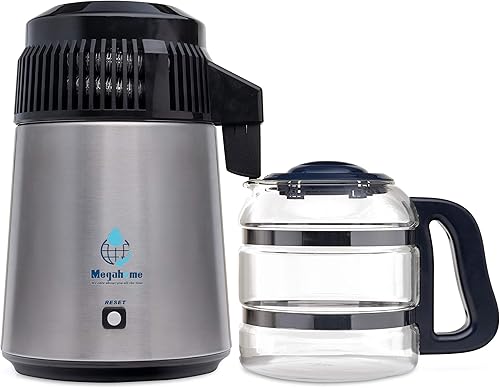
Megahome Countertop Water Distiller, Stainless with Glass Collection
Megahome
- Glass collection bottle — distilled water never touches hot plastic
- Full stainless steel boil chamber and condensing coil
- One gallon in roughly 5.5 hours
- UL listed, with a long-standing US support operation
- The distiller the home-distilling community measures others against
- 4.5★ from 3,100+ owners
Why we picked it: Megahome has been the benchmark in home distillation for two decades, and the details explain why. Distilled water is aggressive — ultra-pure water leaches whatever it touches — so the glass collection bottle isn't a luxury; it's what keeps your very pure water from picking up plastic taste at 200°F. Stainless everywhere the water travels, a UL listing, and three thousand owners averaging 4.5 stars make this the boring, correct answer.
2. Best Value: VEVOR 1.1 Gallon Water Distiller, 750W

VEVOR 1.1 Gallon Water Distiller, 750W
VEVOR
- 1.1 gallons per cycle at 750 watts
- BPA-free container and stainless boil chamber
- Costs meaningfully less than the premium picks
- Simple one-button operation with auto shutoff
- VEVOR's scale keeps parts and replacements available
- 4.2★ from 2,100+ owners
Why we picked it: VEVOR's approach across every category it enters is the same: the essential function at a disruptive price, sold in volumes that keep the review base honest. The 750W distiller does exactly what the premium units do — boil, condense, collect, shut off — with a plastic collection vessel as the main concession. Two thousand owners at 4.2 stars is a solid record at this price, and for appliance water, humidifiers, and CPAP use the value is unbeatable.
3. Best Capacity: VEVOR 6L / 1.6 Gallon Water Distiller
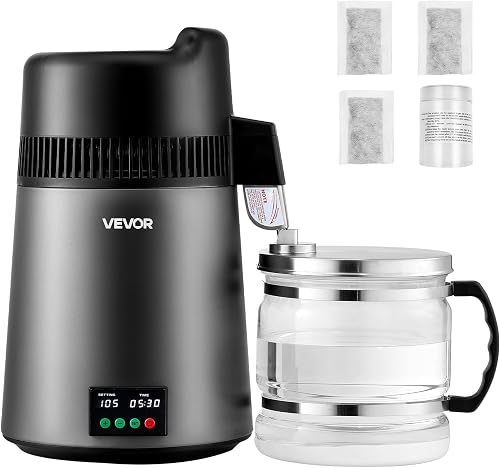
VEVOR 6L / 1.6 Gallon Water Distiller
VEVOR
- 1.6 gallons per run — 50% more than standard units
- Fewer cycles to keep a family or homestead supplied
- Same stainless boil chamber construction
- Auto shutoff at cycle end
- Suits CPAP + drinking + appliance demand combined
- 4.2★ from 2,100+ owners
Why we picked it: A standard distiller makes about a gallon per multi-hour cycle, which is fine until the household actually relies on it — drinking water, the CPAP machine, the iron, the batteries. The 6L version's extra half-gallon per run is the difference between running the machine once a day and babysitting it twice. Same construction, same auto-shutoff, same rating; just less often. For a homestead treating distilled water as infrastructure, capacity is the feature.
Comparison Table
| Pick | Distiller | Capacity | Standout | Best for |
|---|---|---|---|---|
| Best Overall | Megahome Countertop Distiller | 1 gal / ~5.5 hrs | Glass collection | Daily drinking water |
| Best Value | VEVOR 1.1 Gallon 750W | 1.1 gal / cycle | 750W | Budget daily use |
| Best Capacity | VEVOR 6L Distiller | 1.6 gal / cycle | Large capacity | Families and homesteads |
What to Look For in a Water Distiller
What distillation removes — and what it doesn't. Boiling and re-condensing leaves behind minerals, heavy metals, fluoride, nitrates, salts, bacteria, and most of what worries people about their water. The caveat: chemicals that boil at or below water's boiling point (some volatile organics) can ride along with the steam, which is why better units add a small carbon post-filter to catch them. Distillation plus carbon is about as thorough as home treatment gets.
Glass vs. plastic collection. Freshly distilled water is slightly aggressive — stripped of minerals, it dissolves a little of whatever it contacts, and it arrives hot. Glass collection (the Megahome's signature) sidesteps the issue entirely; BPA-free plastic is the accepted compromise at lower prices. If taste is your reason for distilling, glass is worth the difference.
Speed and the electricity math. Countertop units make roughly a gallon in five to six hours on 500-750 watts — call it 3-4 kWh per gallon. That's the trade for purity: distillation is slow and energy-hungry compared to filtration. On grid power it's modest money; on an off-grid inverter it's a real load you should schedule for solar-surplus hours.
Distiller vs. reverse osmosis vs. filters. Distillation is the most complete removal but slowest; reverse osmosis gets close on most contaminants with much faster output; gravity filters need no power at all and excel for biological threats. Many resilient households run two: a filter for volume, a distiller for the uses where purity is the whole point.
Cleaning is the ownership experience. Everything the water leaves behind stays in the boil chamber as scale — which is the point, and also the chore. Hard-water households will see impressive mineral cake within weeks. A wide-mouth stainless chamber and a citric-acid soak keep it a five-minute job; neglect it and efficiency drops as the element insulates itself in scale.
Bottom Line: Which Should You Buy?
For daily drinking water: the Megahome Countertop Distiller. Glass collection and a stainless path — the standard for a reason.
For the budget-minded: the VEVOR 1.1 Gallon 750W. The core function at half the price, with a real owner record behind it.
For bigger demand: the VEVOR 6L Distiller. Fifty percent more per cycle — run it once a day instead of twice.
Made up your mind?
Each pick opens on Amazon, where the current price and stock are listed.
Frequently Asked Questions
What is the best water distiller in 2026?
The Megahome Countertop Distiller is our best overall pick for 2026. The VEVOR 1.1 Gallon 750W and the VEVOR 6L Distiller cover the other cases this guide compares. See the comparison table below for specifications and owner ratings, then choose the one that matches your setup.
What does a water distiller remove?
Effectively everything that doesn't evaporate with the water: minerals, salts, heavy metals like lead and arsenic, fluoride, nitrates, bacteria, and sediment. Volatile chemicals with low boiling points can carry over, which is why quality units include a small activated-carbon post-filter to finish the job.
Is distilled water safe to drink every day?
Yes — distilled water is safe to drink. The common concern is that it lacks minerals, but a normal diet supplies vastly more minerals than tap water ever did. Some people find the taste flat at first because that mineral flavor is missing; it's an adjustment, not a hazard.
How long does it take to distill a gallon of water?
Countertop units typically take five to six hours per gallon at 500-750 watts. It's a batch process best run overnight or during the workday — start a cycle, come back to a full jug. Larger-capacity units don't run faster; they simply make more per cycle.
Why does my distiller leave residue in the boiling chamber?
That residue is the point — it's everything the distiller removed from your water: mineral scale, sediment, and dissolved solids that never made it into your drinking jug. The harder your water, the faster it builds. A periodic soak with citric acid or vinegar dissolves it and keeps the heating element efficient.
Can I run a water distiller off-grid?
Yes, but budget for it — a distillation cycle consumes roughly 3-4 kWh per gallon, which is a significant draw on a battery bank. Off-grid households usually schedule distilling for midday solar surplus, or reserve the distiller for high-purity needs and cover drinking volume with a gravity filter. See our battery bank guide for sizing that load.
Keep reading


How this guide was put together
We shortlist from manufacturer spec sheets and manuals, confirm each listing is live on Amazon, and give owner reports from months of use more weight than first-week impressions. Cycle times and energy figures are manufacturer ratings at standard conditions — hard water and cold feed water slow every unit.
Safety note: A distiller is a sustained boiling appliance — run it on a heat-tolerant surface with clearance from walls, and treat the boil chamber and steam path as you would a kettle. Descale regularly; heavy scale can cause overheating. Never distill anything except water.