 Exploring
The ECO-WORTHY Cubix100 48V 100Ah is the best solar battery bank building block — UL9540, UL1973, and CEC listed, which matters if you're pulling a permit. The Cubix100 600Ah six-pack is the fastest way to 30kWh, and the HumsiENK 48V 100Ah is the highest-rated alternative if you want a second source.
A note on scope: these are the best options you can buy on Amazon. If you are specifying a permanent cabin or whole-property system, the brands installers actually favour — EG4, Signature Solar, and Fortress Power — are sold through specialist dealers rather than Amazon, and we earn nothing by saying so. Compare on capability first; buy wherever the right equipment lives.
How We Picked
We compared usable capacity, BMS quality and active balancing, communication protocols (CAN, RS485, RS232) for inverter handshaking, safety listings, and rack form factor. Server rack batteries are a different animal from the 12V drop-ins in our LiFePO4 battery guide and the AGM units in our deep cycle battery picks — these are 48V modules meant to be stacked and wired into a permanent system. Pair them with a compatible inverter charger and confirm protocol support before you order.
1. Best Overall: ECO-WORTHY Cubix100 48V 100Ah LiFePO4 Server Rack Battery

ECO-WORTHY Cubix100 48V 100Ah LiFePO4 Server Rack Battery
ECO-WORTHY
- 5.12kWh per module at 48V nominal
- UL9540, UL1973, and CEC listed — permit-friendly
- Bluetooth monitoring for state of charge and cell balance
- Rack-mount form factor stacks cleanly as you expand
- Communication support for major hybrid inverters
- 4.7★ from 310+ owners, 200+ bought in the past month
Why we picked it: Safety listings are the quiet dividing line in this category. Plenty of 48V batteries are cheaper than the Cubix100, but far fewer carry UL9540 on the system, UL1973 on the battery, and a CEC listing — and if your install needs a permit, an inspector, or an insurance sign-off, that paperwork is the difference between a finished project and a stalled one. Add strong owner ratings and real inverter communication support and it's the module we'd build a bank around.
2. Best Full-Bank Kit: ECO-WORTHY Cubix100 48V 600Ah Server Rack Battery, 6-Pack 30.72kWh
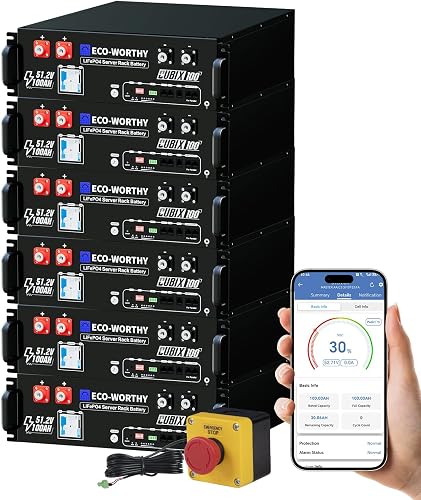
ECO-WORTHY Cubix100 48V 600Ah Server Rack Battery, 6-Pack 30.72kWh
ECO-WORTHY
- 30.72kWh across six matched 100Ah modules
- Matched cells and matched age across the whole bank
- UL9540 and UL1973 listed, CEC listed
- Enough storage for genuine whole-home, multi-day backup
- One order, one delivery, one commissioning session
- 4.7★ from 310+ owners
Why we picked it: Building a bank one module at a time sounds thrifty until you learn what mismatched cell age does to a parallel string — the newest battery ends up doing the most work and aging fastest. Buying six matched modules at once sidesteps that entirely and gets you to 30kWh in a single commissioning session. If you already know you want whole-home storage rather than essential circuits, this is the cheaper path in the long run.
3. Best Alternative: HumsiENK 48V 100Ah LiFePO4 Server Rack Battery with Active Balancing

HumsiENK 48V 100Ah LiFePO4 Server Rack Battery with Active Balancing
HumsiENK
- 5.12kWh in a 3U rack-mount chassis
- UL1973 listed cells
- Active balancing BMS keeps cells matched under load
- Standard 3U height fits common battery racks
- A genuine second source if ECO-WORTHY is backordered
- 4.8★ owner rating
Why we picked it: Single-sourcing a battery bank is a risk you only notice when a module fails in year three and the model has been discontinued. HumsiENK's 48V 100Ah is a credible alternative in the same 3U format, with UL1973-listed cells and an active balancing BMS — which does more real work than the passive balancing found in cheaper modules, especially in a bank that cycles deeply. It carries the highest owner rating of the three.
Comparison Table
| Pick | Battery | Capacity | Configuration | Best for |
|---|---|---|---|---|
| Best Overall | ECO-WORTHY Cubix100 48V 100Ah | 5.12kWh | 48V / 100Ah | Permit-friendly system builds |
| Best Full-Bank Kit | ECO-WORTHY Cubix100 600Ah Kit | 30.72kWh | 48V / 600Ah | Whole-home, multi-day storage |
| Best Alternative | HumsiENK 48V 100Ah | 5.12kWh | 48V / 100Ah | Second-source builds |
What to Look For in a Solar Battery Bank
Why 48V instead of 12V. At the same power, a 48V bank carries a quarter of the current of a 12V one — which means thinner cable, smaller fuses, less voltage drop, and far less heat. Above roughly 3kW of inverter capacity, 12V stops making sense. Every serious residential solar battery storage build lands on 48V for this reason.
Communication protocol matters more than you'd think. A server rack battery that can't talk to your inverter is just a dumb box: you lose accurate state-of-charge reporting and coordinated charge control. Check that the battery's protocol (CAN, RS485, or RS232) appears on your inverter's supported list by model before ordering — "compatible with most inverters" is not a specification.
Active vs. passive balancing. Every LiFePO4 pack drifts out of cell balance over time. Passive balancing bleeds off the high cells as heat and works slowly; active balancing shuttles charge from strong cells to weak ones and keeps a deeply-cycled bank usable for longer. On a bank you intend to keep a decade, it's worth paying for.
Safety listings and your inspector. UL1973 covers the battery, UL9540 covers the complete energy storage system, and a CEC listing matters for some incentive programs. If your install is permitted — and a fixed 48V bank almost always is — these listings determine whether it passes. Unlisted batteries can also complicate a homeowner's insurance claim after a fire, whatever the cause.
Buy the bank you'll want in three years. Mixing battery ages in a parallel string is the most common regret in this category: the newest module works hardest and wears fastest. If you can see 20kWh in your future, buying matched modules up front will cost less and last longer than growing the bank a shelf at a time. Size it against your solar array and your real daily consumption.
Bottom Line: Which Should You Buy?
For a permitted, expandable bank: the ECO-WORTHY Cubix100 48V 100Ah. The listings and the Bluetooth monitoring are worth the small premium.
For 30kWh in one order: the ECO-WORTHY Cubix100 600Ah Kit. Six matched modules beat six batteries bought a year apart.
For a second source: the HumsiENK 48V 100Ah. Active balancing and UL1973 cells in the standard 3U format.
Ready to buy?
Jump straight to our top picks on Amazon — prices shown at click-through.
Frequently Asked Questions
What is the best solar battery bank in 2026?
The ECO-WORTHY Cubix100 48V 100Ah is our best overall pick for 2026. The ECO-WORTHY Cubix100 600Ah Kit and the HumsiENK 48V 100Ah cover the other cases this guide compares. See the comparison table below for specifications and owner ratings, then choose the one that matches your setup.
What is a solar battery bank?
It's a group of batteries wired together to store the energy your solar array produces, so you can use it at night or during an outage. Modern residential banks use 48V LiFePO4 modules in a server-rack format, wired in parallel to build capacity — a single 100Ah module holds about 5.12kWh, and six of them get you past 30kWh.
How many kWh of solar battery storage do I need?
Start with your daily consumption from your utility bill. A conservative off-grid rule is two to three days of autonomy, since a cloudy stretch shouldn't leave you dark. A household using 15kWh a day would want 30-45kWh of storage for full off-grid living, or 10-15kWh if the bank only needs to cover essential circuits during outages.
What is a 48V server rack battery?
It's a LiFePO4 battery built in the same rack-mount form factor used for computer servers — typically 3U tall, sliding into a standard rack or stacked in a cabinet. The format makes expansion tidy and cooling predictable, and nearly all of them include a BMS with a communication port so the inverter can read the battery's real state.
Can I mix different brands of batteries in one bank?
It's strongly discouraged. Different BMS implementations, cell chemistries, and internal resistances mean the modules won't share load evenly, and the mismatch accelerates wear on whichever pack is strongest. If you must expand with a different brand, wire it as a separate bank on its own inverter input rather than paralleling it with the original string.
How long do LiFePO4 solar batteries last?
Quality LiFePO4 modules are typically rated for 4,000-6,000 cycles to 80% of original capacity. Cycled once a day, that's roughly 11-16 years before they drop to 80% — and they keep working past that, just with less capacity. Keeping them out of extreme heat is the single biggest thing you control.
Related Guides


How We Research
Picks are based on manufacturer specifications, current Amazon availability, and patterns across verified owner reviews. Capacity and cycle figures are manufacturer ratings — confirm inverter communication compatibility and safety listings before buying.
Safety note: A 48V battery bank stores enough energy to start a fire or deliver a serious shock through a dropped tool. Have fixed installations done or inspected by a licensed electrician, fuse every parallel string, and never work on a live bank without insulated tools and eye protection.